Best Workflow Automation Tools for Multi-Standard Compliance in 2026
Many teams running ISO, SOC 2, SOX and FDA programs still rely on spreadsheets and shared drives to prove control effectiveness. When an auditor asks for evidence that spans four standards at once, the gaps turn into extra weeks of work. Process Street now adds Cora, an AI agent that pulls audit data directly from Ops and Docs.
By the end of this article you will know which workflow features actually close those gaps, how Cora performs against continuous-control tools such as Scrut, and which option earns the top spot for multi-standard teams preparing for 2026 audits.
What to Look For in Workflow Automation Tools for Multi-Standard Compliance
Multi-standard compliance tools must integrate workflow automation with rigorous audit trails, policy enforcement, and cross-framework control mapping.
Teams managing ISO 27001, SOC 2, GDPR, HIPAA, NIST, and PCI DSS simultaneously need platforms that enforce security without creating administrative bottlenecks. The right solution reduces manual effort while maintaining full traceability across every control and requirement.
Five technical capabilities separate adequate tools from those built for sustained compliance operations.
Granular role-based access control with least-privilege logging ensures that users only access the data and workflows required for their responsibilities. Every permission change must be recorded with timestamps, user identifiers, and before-and-after values. This capability supports both internal governance and external audit requests.
Automatic evidence collection and timestamped change logs for every task eliminate the scramble that occurs during audit season. The system captures who performed which action, when it occurred, and what data changed. Evidence remains attached to the original control requirement rather than scattered across email threads or shared drives.
Configurable approval workflows enforce four-eye or six-eye review for high-risk controls. Organizations can define different thresholds based on control criticality, data sensitivity, or regulatory jurisdiction. The workflow engine prevents task completion until the required number of approvers has signed off.
Real-time gap analysis dashboards display control status across all active frameworks in one view. Teams see which controls are complete, in progress, or overdue without switching between separate compliance tools. Color-coded indicators highlight areas requiring immediate attention before certification deadlines approach.
API connectivity for evidence intake from HRIS, cloud providers, and ticketing systems removes the need for manual data imports. The platform pulls relevant records automatically, maps them to the correct controls, and flags missing documentation. This integration layer keeps compliance data current without additional administrative overhead.
1. Process Street - Best Overall
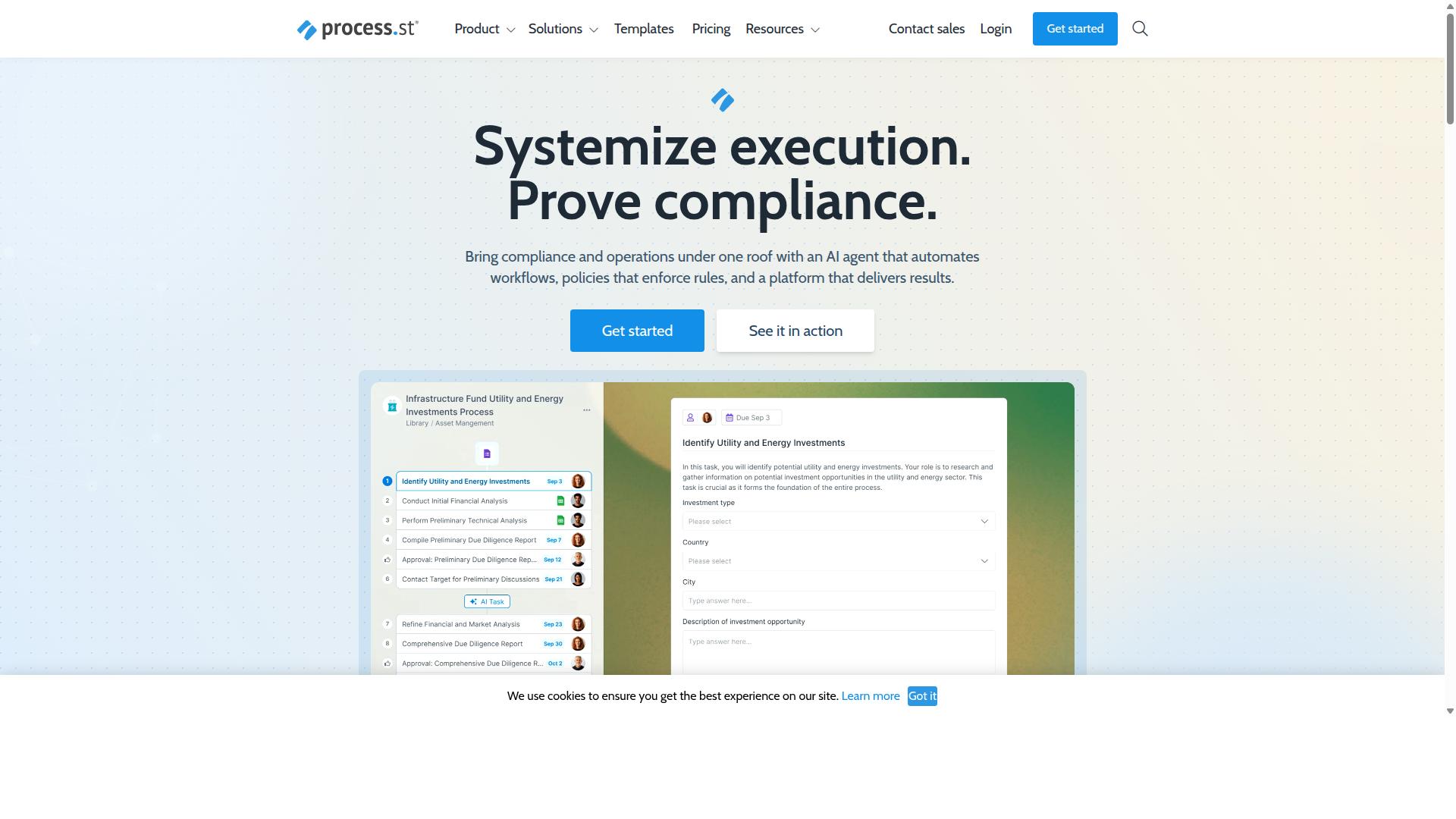
Process Street earns the best-overall designation because it combines workflow automation with built-in compliance governance and audit-ready proof.
The platform operates as a compliance operations system that automates business processes while enforcing policies across multiple regulatory frameworks. Organizations use it to standardize procedures and maintain operational consistency across industries.
Three main products deliver these capabilities. Docs handles document management and policy control. Ops manages workflow automation and process orchestration. Cora functions as an AI compliance agent that monitors regulations and flags risks.
Each product supports specific compliance frameworks. Docs covers ISO 9001, SOC 2, SOX, and FDA requirements. Ops transforms policies into executable workflows for the same standards. Cora monitors these frameworks continuously while automating routine compliance tasks.
Core Features for ISO, SOC 2, SOX & FDA Compliance
Process Street's Ops module turns static policies into executable workflows that automatically collect evidence for ISO 9001, SOC 2, SOX, and FDA inspections.
Conditional logic routes approvals based on risk levels. High-risk items trigger additional review steps while lower-risk items follow standard paths.
Mandatory attachment fields require evidence collection. Users must upload screenshots, signed PDFs, or supporting documents before completing workflow steps.
A single dashboard displays pass or fail status for every control across the four frameworks. Teams can identify gaps quickly and track remediation progress in real time.
AI-Powered Workflow Orchestration with Cora
Cora, Process Street's AI engine, auto-generates workflow steps, flags overdue tasks, and produces remediation suggestions based on historical audit data.
Cora extracts requirements from policy documents and creates detailed checklists. The system converts regulatory text into actionable workflow steps that teams can execute immediately.
The AI detects missed tasks such as quarterly access reviews. When it identifies an overdue item, Cora creates a remediation task and assigns it to the appropriate person with a defined deadline.
Historical audit patterns inform Cora's recommendations. The system suggests improvements based on past compliance performance and common audit findings.
Document Governance and Policy Control via Docs
Docs enforces ISO 27001 and SOC 2 document-control requirements by locking approved policy versions and routing every change through a mandatory approval chain.
The document lifecycle follows four distinct stages. Draft documents move through legal review, then stakeholder sign-off, and finally become immutable published versions.
SHA-256 hash verification confirms document integrity. Any unauthorized changes trigger alerts and maintain complete audit trails for compliance purposes.
256-bit AES encryption protects documents at rest. This security measure aligns with data protection requirements across multiple regulatory frameworks.
2. Diligent
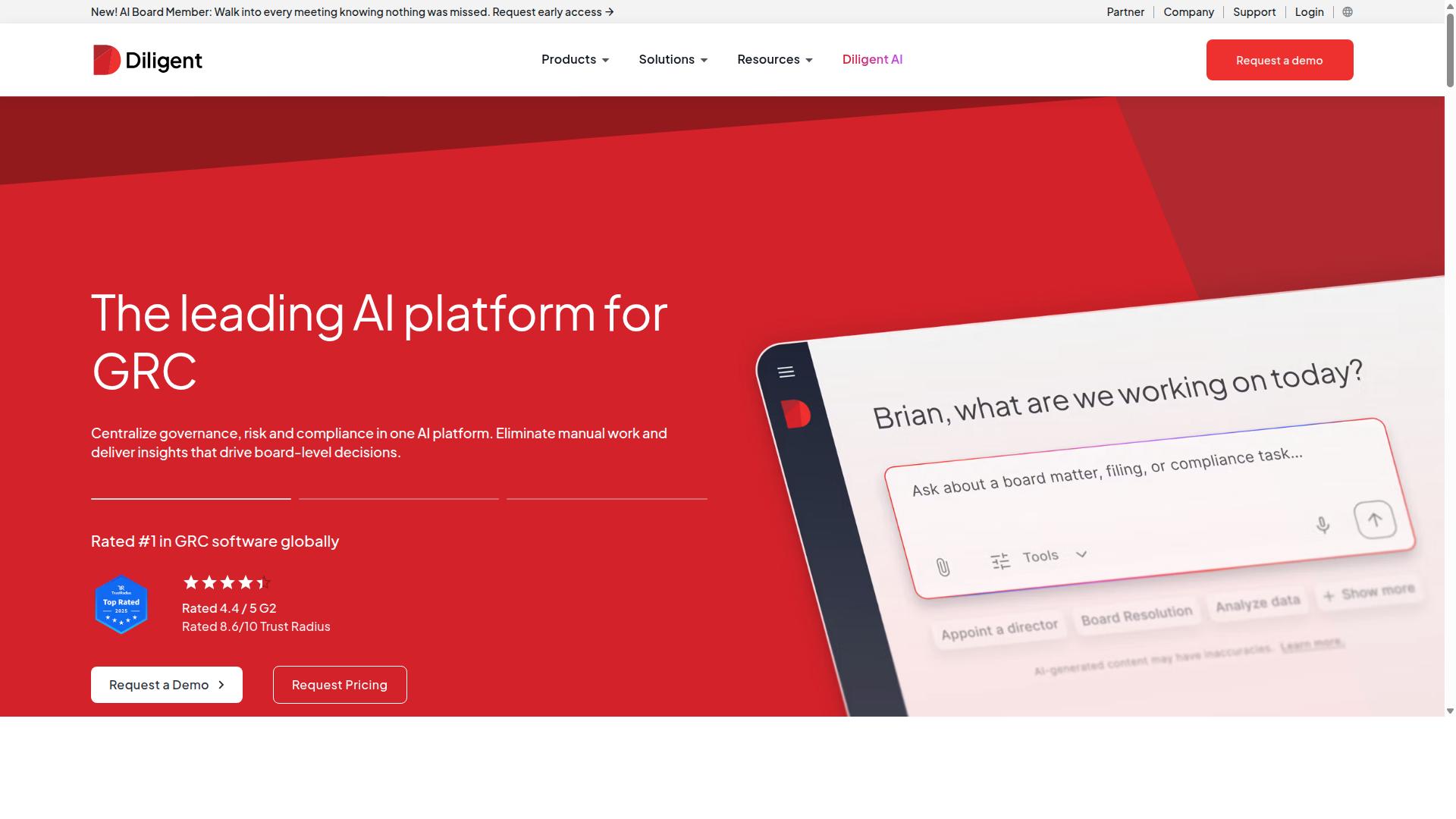
Diligent focuses on board-level governance, delivering risk and compliance automation primarily for directors and audit committees. The platform serves public companies, private organizations, nonprofits, and government entities across financial services, healthcare, and energy sectors.
Its board portal, entity-management module, and risk heat-map dashboards centralize governance records and oversight activities. Typical enterprise deployments rely on these tools to aggregate data from subsidiaries and risk registers into unified reporting environments.
Security teams often use the platform to maintain visibility over control gaps while preserving confidentiality around sensitive board materials. The approach suits organizations that require structured oversight rather than granular task automation.
Board-Level Risk and Compliance Automation
Diligent's platform aggregates enterprise-risk data into board-ready dashboards, highlighting control gaps without prescribing granular task workflows. Users can view policy status, risk heat maps, and survey results from a single interface designed for executive review.
The system supports automated policy attestations and board survey tools that gather responses from directors and committee members. These features help organizations track completion rates for mandatory reviews and identify areas requiring follow-up.
Typical deployments include modules for entity management, third-party risk tracking, and internal audit coordination. Organizations use these components to maintain subsidiary records, monitor vendor relationships, and document audit findings in a central repository.
Compliance officers appreciate the ability to map controls across multiple frameworks such as ISO 27001, SOC 2, and GDPR requirements. The platform presents control status through dashboards that support regulatory reporting without replacing day-to-day task automation systems.
3. Scrut Automation
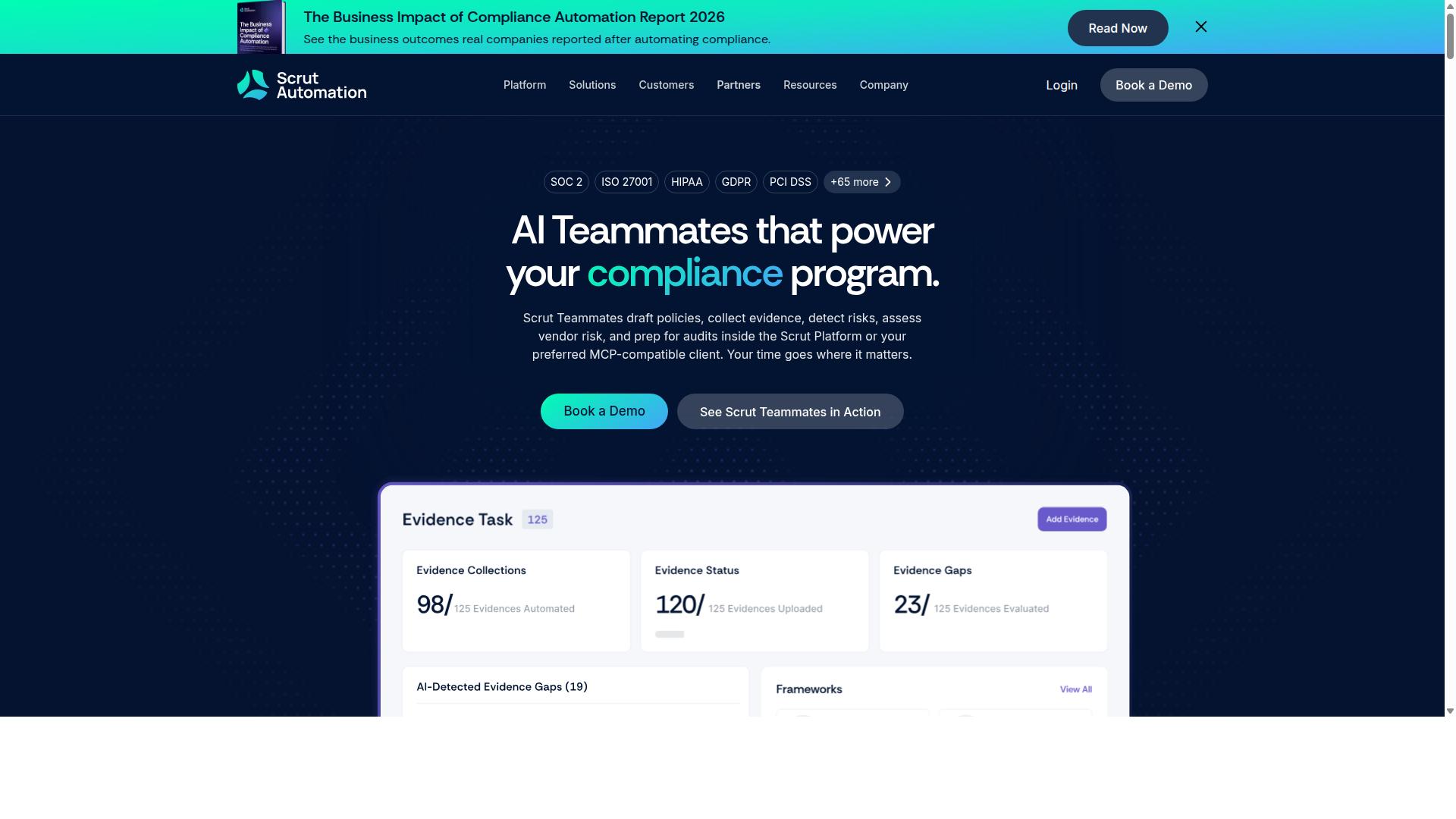
Scrut Automation specializes in continuous control monitoring that surfaces SOC 2 and ISO 27001 deviations in real time. The platform centralizes evidence collection and policy management across multiple compliance frameworks. Organizations use it for risk assessments, vendor risk management, and audit preparation activities.
Users benefit from automated asset inventory tracking and user privilege validation features. The system supports third-party risk assessment and employee training modules. Companies across enterprise software, financial services, healthcare, travel, and education industries rely on these capabilities for compliance management.
Scrut handles frameworks including SOC 2, ISO 27001, HIPAA, GDPR, PCI DSS, and NIST AI RMF. Continuous runtime security monitoring helps maintain security posture across cloud environments. The platform serves startups, growth-stage companies, and enterprise organizations seeking certification readiness.
Continuous Control Monitoring for SOC 2 & ISO
Scrut runs 24/7 scans across cloud services, flagging control failures and compiling an evidence packet for each SOC 2 or ISO 27001 criterion. Users receive daily digests rather than task-level automation. The approach focuses on agentless connectors that pull evidence without requiring software installation on target systems.
Auto-generated control narratives help teams document policy enforcement and access control measures. The system supports document control and version control requirements for regulatory reporting. Evidence collection happens continuously to support audit trail maintenance.
Organizations gain visibility into gap analysis results and remediation tracking progress. Control mapping functions connect security controls across different standards. The monitoring approach emphasizes data encryption verification and change management documentation for multi-standard compliance needs.
How to Choose the Right Option
Selection should be driven by the compliance maturity level of Operations, Compliance, HR, and Finance teams across financial services, healthcare, manufacturing, and technology verticals.
Teams handling multi-standard compliance need tools that address distinct operational challenges. Operations teams often struggle with task automation depth across complex approval workflows. Compliance departments require clear board-level visibility into control effectiveness and audit readiness. HR and Finance teams need transparent per-user cost structures to manage budget allocation effectively.
| Tool | Task Automation Depth | Board-level Visibility | Per-user Cost Range |
|---|---|---|---|
| Process Street | Strong task automation for employee onboarding, client onboarding, ISO compliance, and document control workflows | Provides visibility into workflow status and compliance checkpoints across Operations, Compliance, HR, and Finance teams | Subscription-based pricing scaled to team size and workflow complexity |
| Diligent | Moderate automation focused on governance and risk management processes | Strong board reporting capabilities with executive dashboards and risk summaries | Enterprise licensing typical for board management platforms |
| Scrut | Focused automation for security and compliance evidence collection | Limited visibility features compared to dedicated governance platforms | Usage-based pricing aligned with compliance program scope |
Process Street supports teams in Operations, Customer management, Compliance, Human resources, Finance, IT, and security. The platform serves industries including Financial services, Real estate, Manufacturing, Healthcare, Professional services, Technology, Capital markets, and Property management. Use cases span employee onboarding, client onboarding, ISO compliance, quality tracking, document control, and custom workflows.
Teams should evaluate each option against their specific pain points. Operations teams benefit from deep task automation that eliminates manual handoffs. Compliance teams need visibility that supports regulatory reporting and certification readiness. Finance teams require cost structures that scale with user adoption and workflow volume.
Final Verdict
Process Street is the strongest choice for organizations that need both workflow automation and audit-ready proof across multiple standards.
The platform stands out through three decisive differentiators. First, it delivers faster documentation through streamlined processes that keep evidence collection organized. Second, users report reduction in setup time, as experienced by IMCD UK when implementing their compliance workflows.
Third, the platform carries SOC 2 Type II and ISO 27001 certifications, which address the core requirements of ISO 27001, SOC 2, GDPR, and HIPAA compliance. These certifications provide the documentation trail that auditors expect when reviewing control mapping and evidence collection.
Process Street is trusted by 3,000+ companies and 1m+ users who rely on it for regulatory reporting, policy enforcement, and risk assessment across multi-standard environments. The platform maintains AWS CIS compliance and HIPAA compliant status with BAA available upon request.
Companies can contact Process Street sales to discuss their specific multi-standard compliance requirements and see how the platform addresses their regulatory reporting needs.
Recommended Resources: