Pega vs Process Street for Enterprise Workflow Automation
Many teams need workflow software that enforces policies and produces audit records without extra manual steps. Pega and Process Street both claim to handle enterprise processes, yet their approaches differ sharply on compliance checks and document control.
By the end of this article you will see the exact differences in audit-ready workflows, AI orchestration, and policy governance so you can pick the platform that matches your compliance and process requirements.
Quick Verdict: Pega vs Process Street for Enterprise Workflow Automation
Process Street delivers SOC 2 Type II and ISO 27001 certified compliance automation, while Pega focuses on enterprise-scale BPM suites. Teams seeking audit-ready proof gain immediate advantages from Process Street's certified approach. Organizations requiring heavy customization may find Pega's low-code case management more suitable.
IMCD UK reported a 75% setup-time reduction when implementing Process Street for enterprise workflow automation. This speed advantage stems from pre-built process templates and streamlined configuration. Pega typically requires longer implementation cycles for complex BPM deployments.
Teams prioritizing compliance choose Process Street for its SOC 2 Type II certification and ISO 27001 certification. These credentials provide documented proof for regulatory requirements. Pega offers general enterprise BPM capabilities without the same certification focus.
Teams needing extensive customization may prefer Pega's low-code platform approach. Process Street excels when audit trails and compliance documentation matter most. The choice depends on whether organizations value certification proof or customization flexibility.
At a glance: how Process Street compares to Pega, Process Street for Enterprise Workflow Automation on the features that matter most.
| Feature | Process Street | Pega | Process Street for Enterprise Workflow Automation |
|---|---|---|---|
| Enterprise Workflow Automation | ✓ | ✓ | ✓ |
What Is Process Street?
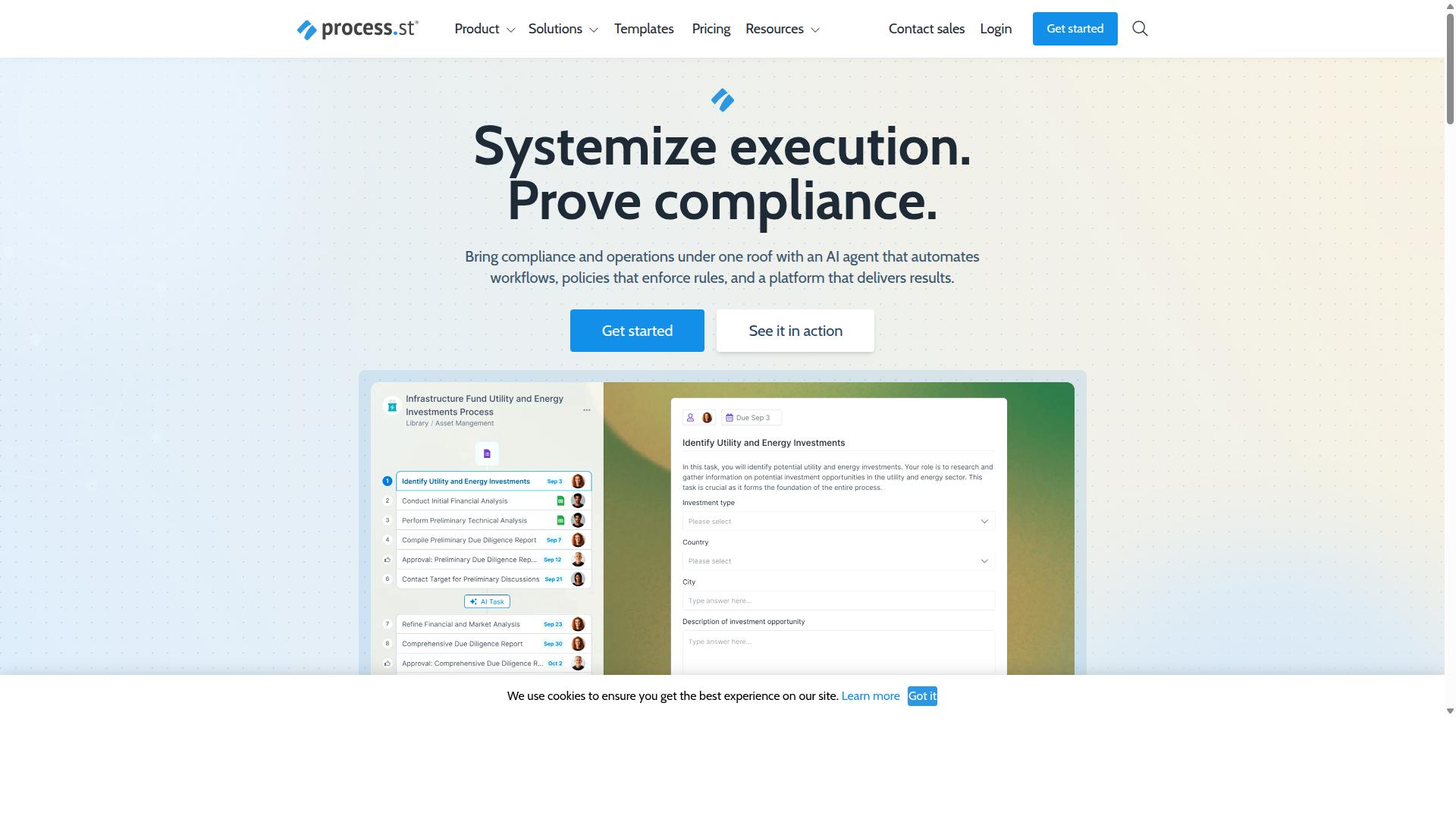
Process Street is a compliance operations platform that automates business processes and supplies audit-ready proof for ISO 9001, SOC 2, SOX, and FDA standards.
The platform offers three core products that convert policies into AI-powered workflows. Docs handles document management and policy control.
Ops manages workflow automation and process orchestration. These products work together to standardize operations across enterprise environments.
The forthcoming AI layer, named Cora, functions as an AI compliance and risk agent. Each component addresses specific workflow automation needs.
Organizations use these products to enforce business policies while maintaining operational consistency. The platform proves compliance through documented workflows and audit trails.
When comparing Process Street to Pega for enterprise workflow automation, the three-product structure provides clear advantages. Docs centralizes policy control, while Pega typically requires separate document systems.
Ops orchestrates workflows directly from policies, reducing the need for complex BPM configuration. This approach simplifies process governance compared to traditional enterprise platforms.
Cora adds AI-powered compliance checking that other workflow automation tools handle through manual reviews or custom development.
What Is Pega?
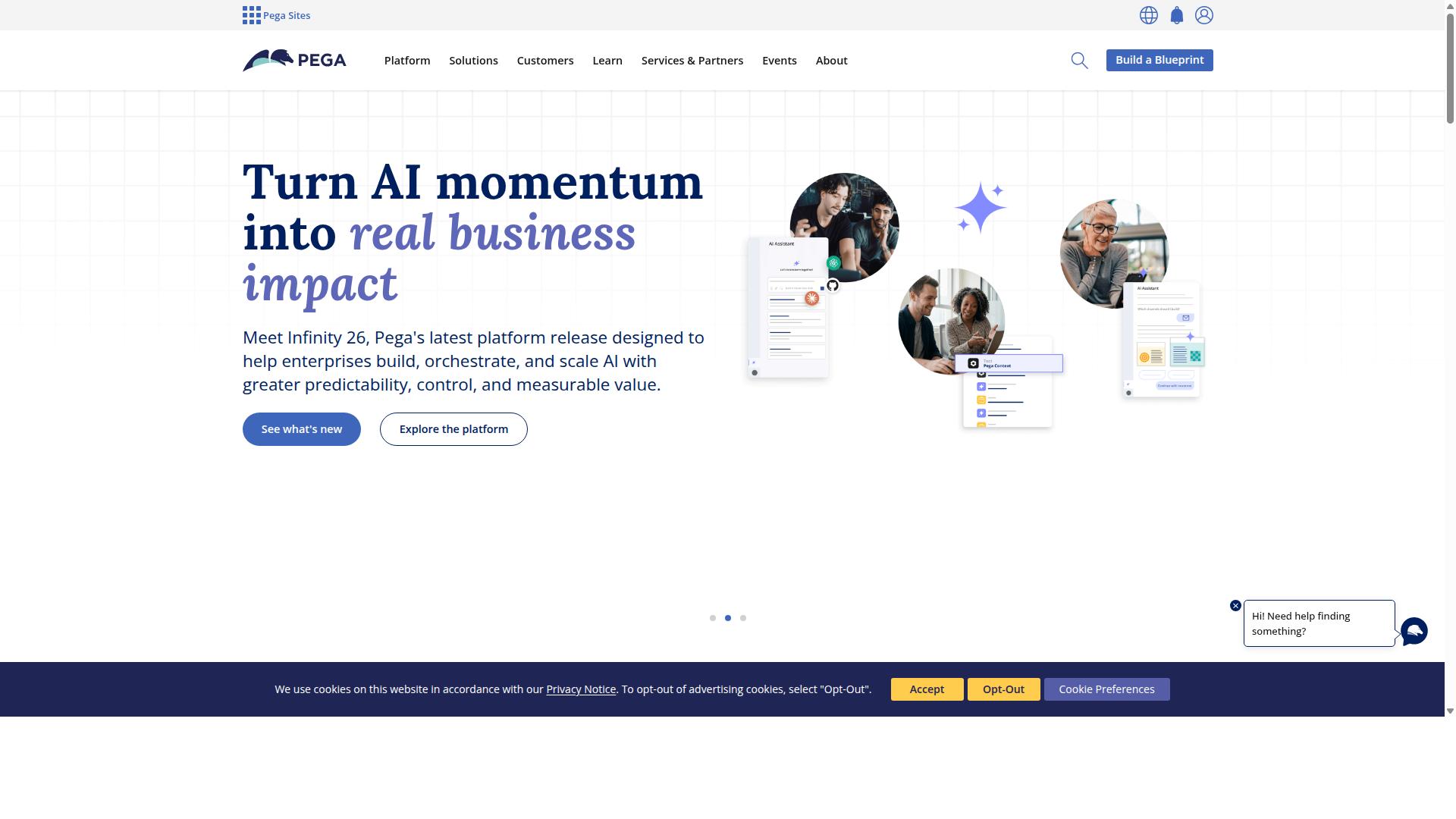
Pega Systems offers a unified low-code BPM and case-management suite used by large enterprises for customer engagement and back-office orchestration.
The platform centers on BPMN modeling that lets teams map out processes with standardized visual notation. This approach helps organizations maintain consistency across complex approval workflows and multi-step procedures.
Pega also incorporates RPA bots that handle repetitive tasks such as data entry and system updates. These bots work alongside human workers to reduce manual effort in routine operations.
Deployment options include both cloud deployment and on-premise deployment models. This flexibility allows companies to choose the infrastructure approach that aligns with their security and compliance needs.
The low-code platform reduces development time by providing pre-built components and visual design tools. Business users can participate more directly in process creation without extensive coding knowledge.
Case management capabilities help teams track individual instances through various stages of work. This feature supports scenarios where processes require flexibility rather than rigid step sequences.
Enterprise workflow automation often demands integration with existing systems across the organization. Pega connects with legacy applications and modern software through standard interfaces and custom connectors.
What Is Process Street for Enterprise Workflow Automation?
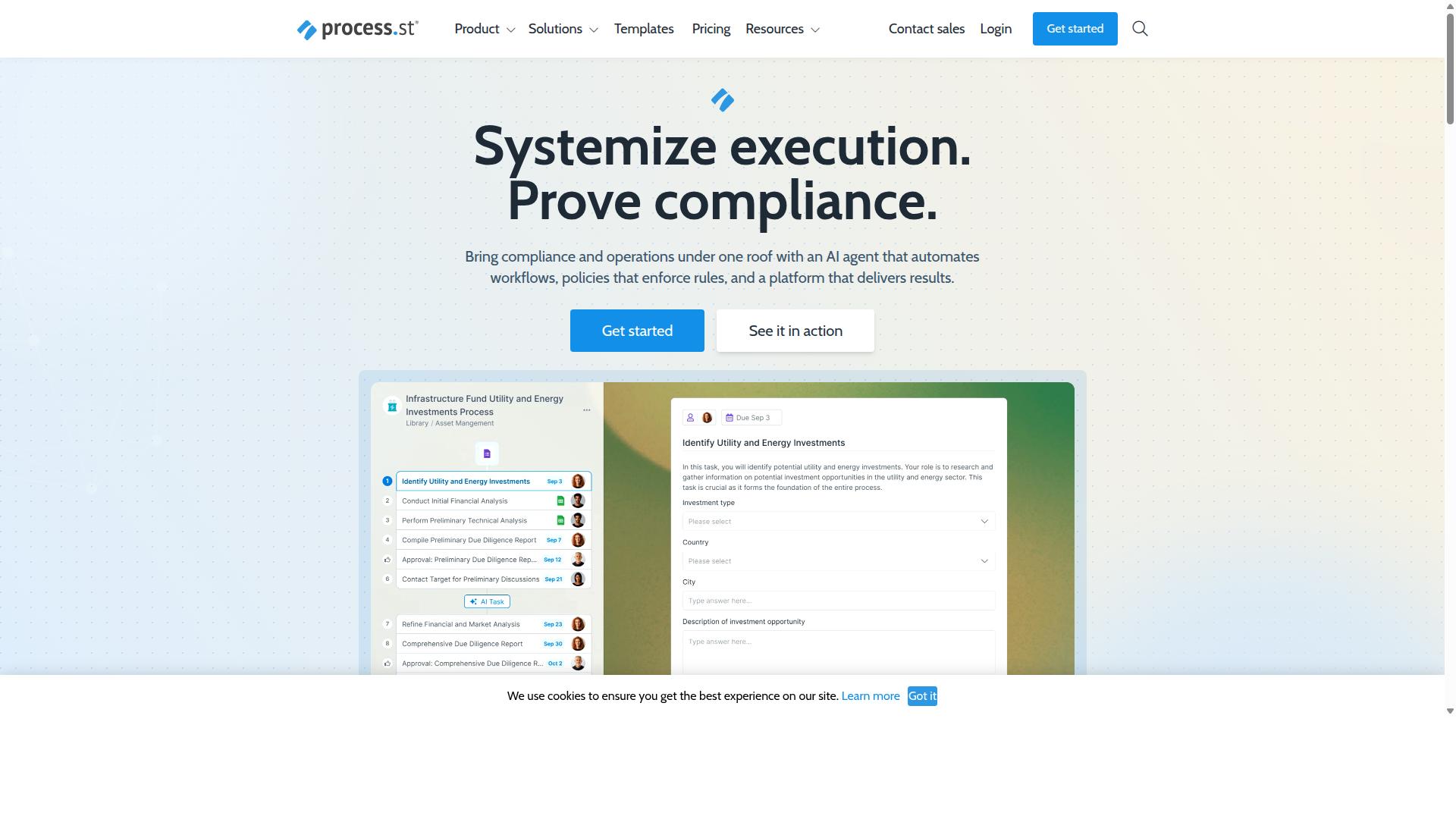
Process Street scales to enterprise needs by layering role-based access, API integrations, and unlimited workflows on top of its compliance-first engine. The platform delivers workflow automation and process orchestration that turns policies into AI-powered workflows through its Ops offering.
Startup plan users gain access to unlimited workflows while managing up to 5,000 Data Set records under SOC 2 Type II certification. This tier suits growing organizations that require structured process management without exceeding data thresholds.
Pro plan expands capacity to 10,000 Data Set records while retaining the same unlimited workflow structure and security standards. Mid-sized enterprises benefit from increased data handling alongside advanced automation features.
The Enterprise plan removes record limits entirely while maintaining SOC 2 Type II certification across all deployments. Organizations handling complex compliance requirements gain access to role-based access controls and extensive integration options.
Process Street supports document management through its Docs product, which provides full governance for ISO 9001, SOC 2, SOX, and FDA standards. This combination of workflow automation and policy control creates a unified approach to enterprise compliance.
The Cora AI compliance agent monitors regulations, automates work, and flags risks continuously. Teams receive proactive alerts when processes deviate from established compliance frameworks or regulatory requirements.
Platform features include Process AI, Automations, Analytics, Apps, and Integrations. Organizations connect with Zapier, Microsoft Power Automate, Tray.io, Make, and public API access to extend workflow capabilities across existing technology stacks.
Features Compared
Three feature clusters, compliance, AI orchestration, and document governance, highlight where Process Street and Pega diverge for enterprise teams. These areas often determine which platform fits an organization best.
Process Street offers integrated tools across its Docs, Ops, and Cora products to support regulated environments. Pega provides case management and decisioning capabilities that require more manual setup in these same areas.
Each cluster addresses specific workflow needs. Teams evaluating platforms should examine how each solution handles audit requirements, AI automation, and document control within enterprise workflows.
Compliance & Audit-Ready Workflows
Process Street auto-generates SOC 2 Type II and ISO 27001 audit trails, whereas Pega relies on manual configuration for similar evidence packs. This difference affects how quickly teams can prepare for external reviews.
Process Street provides native audit logs, policy versioning, and one-click export for ISO 9001, SOX, and FDA requirements. These features support regulated industries that need consistent documentation.
Pega offers general audit capabilities that teams can configure to meet their needs. The setup process requires additional work compared to pre-built compliance features.
Process Street includes Cora as an AI compliance agent that monitors regulations and flags risks continuously. This automated monitoring reduces the daily workload for compliance teams.
AI-Powered Process Orchestration
Process Street's AI layer converts static checklists into dynamic, conditional workflows that react to real-time data. Pega's decisioning engine focuses on customer journeys instead of internal process automation.
Process Street provides 100 automation actions per month in the Startup plan and unlimited actions in the Enterprise plan. This scaling model supports growing teams without hitting usage limits.
Process Street's Ops product turns policies into AI-powered workflows that connect with external systems. The platform integrates with Zapier, Microsoft Power Automate, Tray.io, Make, and provides public API access for custom connections.
Pega handles orchestration through its low-code platform with general automation features. The approach requires more configuration for similar outcomes compared to Process Street's native AI capabilities.
Document & Policy Governance
Process Street centralizes policy documents and links each clause directly to workflow steps, eliminating version drift. Pega stores documents within its case repository without the same level of direct workflow connection.
Process Street's Docs product provides policy-to-workflow traceability and role-based permissions. These features help teams maintain document accuracy across multiple departments and approval cycles.
Pega manages documents as part of its broader case management system. Teams can access and update files within individual cases, though the connection to broader policy governance remains less direct.
Process Street's approach creates clear connections between policy changes and workflow updates. This traceability supports organizations that need to demonstrate how policies translate into daily operations.
Pricing Compared
Process Street lists three transparent tiers, Startup, Pro, and Enterprise, while Pega's pricing is quote-based and typically includes license, cloud, and consulting fees.
Organizations seeking predictable costs find Process Street's published structure helpful. The Startup plan supports 5 users, 10 guests, and 10 apps. This entry point allows small teams to test workflow automation without large upfront commitments.
The Pro plan removes most restrictions. Teams gain unlimited workflows and tasks, custom user counts, and expanded automation actions. Limits scale with actual usage through flexible monthly allocations rather than fixed ceilings.
Enterprise customers receive unlimited everything. This includes custom data set records, unlimited public API access, and dedicated success management.
Additional Enterprise benefits include priority support, fully managed workflows, and personalized team training. Bulk document import and process consulting services come standard with this tier.
Pega's enterprise licensing model follows a different approach. Quotes typically bundle platform access, infrastructure, and professional services into single agreements. The exact structure varies by deployment size and support requirements.
Process Street's published tiers allow direct cost comparisons. Teams can evaluate their user counts, automation needs, and data requirements against specific plan limits.
Enterprise organizations often prefer transparent pricing when planning multi-year budgets. Process Street's structure supports this type of financial planning more directly than quote-based models.
Who Should Choose Process Street
Teams in finance, healthcare, and professional services that need SOC 2 Type II and ISO 27001 evidence out-of-the-box select Process Street. These organizations value enterprise workflow automation that supports compliance requirements without custom configuration. Process Street serves operations, customer management, compliance, human resources, finance, IT and security teams across multiple industries.
Financial services and capital markets companies use the platform for regulatory documentation and audit requirements. Healthcare organizations rely on it for patient data handling procedures and quality tracking. Professional services firms apply the same workflows to client onboarding and project delivery processes.
Real estate and property management companies choose Process Street for lease administration and maintenance coordination. Manufacturing operations apply it to quality control checklists and safety protocols. Technology companies implement it for employee onboarding and IT security procedures.
The platform supports 3,000 plus companies and over 1 million users who need structured business process management with built in compliance documentation. These organizations prioritize no-code platform capabilities that allow non technical teams to maintain their own workflows.
Specific roles that benefit include Compliance Officers, HR Ops, and Finance Controllers. Compliance Officers use the platform for ISO compliance and document control requirements. HR Operations teams manage employee onboarding processes with consistent checklists. Finance Controllers apply workflow templates to approval processes and financial reporting procedures.
Who Should Choose Pega
Large organizations with complex, cross-departmental case management requirements and dedicated BPM teams often choose Pega. These enterprises typically need extensive customization capabilities to handle intricate business rules across multiple departments.
Enterprise scalability becomes essential when workflow orchestration spans thousands of users with varying compliance standards. Pega supports on-premise deployment and offers robust process modeling tools that accommodate highly specialized business logic.
Organizations managing regulated industries often require detailed audit trails and process governance frameworks. Pega provides comprehensive case management features including rule-based decision engines and extensive process versioning capabilities.
Process integration requirements drive selection when existing legacy systems demand extensive API connections. Pega accommodates robotic process automation scenarios through its platform architecture.
Enterprises with dedicated technical teams benefit from Pega's low-code platform approach. This setup allows internal developers to customize workflows while maintaining control over complex business process management requirements.
Who Should Choose Process Street for Enterprise Workflow Automation
Enterprises balancing global scalability with strict compliance choose Process Street when they need unlimited workflows and data-residency options across US, EU, UK, Canada, Australia, and UAE.
Global teams often face challenges when scaling workflow automation across regions. Process Street addresses these concerns through flexible data residency that meets local regulations without sacrificing performance.
Organizations that require unlimited users, guests, and automations benefit from a platform designed for rapid expansion. Enterprise plan features remove the typical constraints that hinder growth in large-scale operations.
Support reliability matters when operations span multiple time zones. Process Street maintains a 98% customer-support rating, which helps teams resolve issues quickly regardless of their location.
Many enterprises compare Process Street against Pega when evaluating workflow automation platforms. The unlimited capacity model provides clear advantages for organizations that anticipate growth in user numbers or automation complexity.
Data residency requirements vary significantly between jurisdictions. Regional options in six locations allow enterprises to maintain compliance while keeping workflows accessible to distributed teams.
Organizations with complex approval workflows and process governance needs find the unlimited automations particularly valuable. This structure supports both current requirements and future expansion without additional licensing considerations.
Final Verdict
Process Street wins for compliance-heavy teams that want certified audit trails and 75% faster setup. Pega suits enterprises needing extensive custom development.
Process Street serves over 3,000 customers with enterprise workflow automation that prioritizes compliance and speed. The platform carries SOC 2 Type II and ISO 27001 certifications that meet strict audit requirements common in regulated industries.
Teams gain quick access through AWS Marketplace, where enterprise demos are available directly. Support channels include email and chat with a 5-minute average response time and 98% customer rating.
Pega offers a low-code platform with deeper customization options for organizations that need extensive development resources. This approach works when internal teams can dedicate significant time to building and maintaining complex workflows.
Process Street focuses on certified compliance features and rapid deployment that reduce the time between purchase and active use. The combination of security certifications and marketplace availability makes it practical for teams that need reliable audit trails without heavy implementation overhead.
Enterprises evaluating both options should consider their development capacity and compliance requirements. Teams that value certified security standards and shorter setup periods typically find Process Street provides the balance they need for enterprise workflow automation projects.
Recommended Resources: