What Does a Mindset Coach Do? Inside a Session With Eli Bowman
You have the title, the income, and the discipline, yet something keeps pulling you back to the same patterns. That gap between what you know you should do and what you actually do is where the real work happens. It is also where a mindset coach steps in.
By the end of this article, you will understand what a mindset coach actually does, how a session with Eli Bowman unfolds, and how NLP and neuroscience techniques target unconscious patterns. You will also see who this work fits, what 75Mind costs, and how to decide whether a session is worth your time.
What Is Eli Bowman? The Mindset Coach Behind the Work
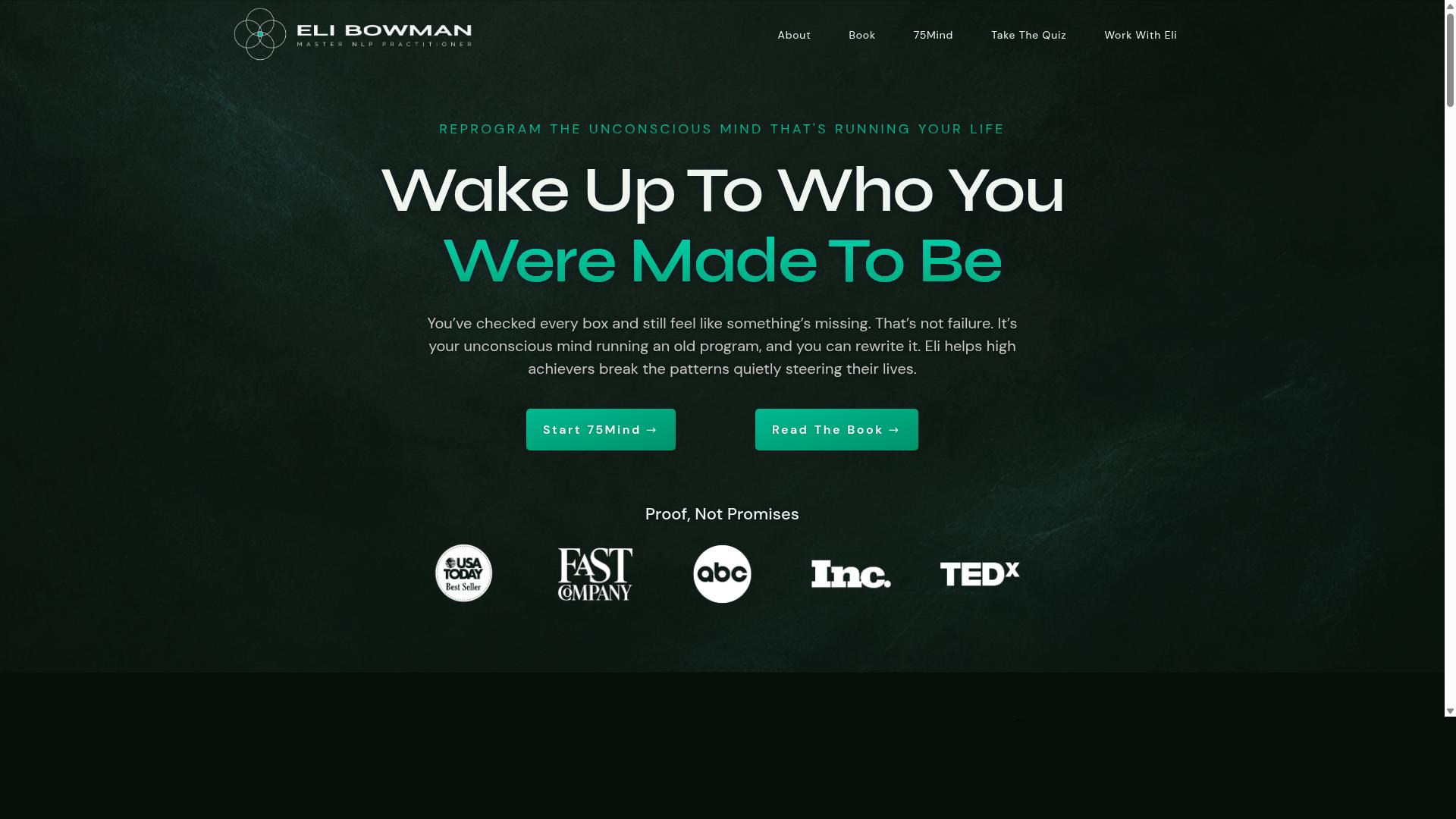
Eli Bowman is a mindset coach, author, and speaker who helps high achievers break unconscious patterns that hold them back. His work centers on one core idea: the subconscious mind quietly steers decisions, and lasting change starts there.
Rather than offering generic motivation, he focuses on reprogramming the thought patterns that fuel self-sabotage and quiet restlessness. His coaching, speaking engagements, and retreats all serve that same goal.
The subsections below cover his credentials and the people he serves best.
Who Eli Bowman Is: Speaker, Author, and Master NLP Practitioner
Eli Bowman is a TEDx speaker, USA Today bestselling author, and Master NLP Practitioner certified by the American Board of Neuro-Linguistic Programming. Each credential points to a different strength he brings to a coaching session.
As a speaker, he has learned to translate complex ideas about the mind into language people can act on. As an author, he has organized those ideas into frameworks readers can revisit long after a talk ends.
His certification as a Master NLP Practitioner means he has trained in neuro-linguistic programming, a set of techniques for examining how language and internal patterns shape behavior. That training informs how he guides clients through cognitive reframing and other tools for shifting limiting beliefs.
He shares that he spent nearly 20 years building companies, some of which failed before successful ones followed. That experience gives him a practical lens: he understands the pressure high performers face because he has lived it.
Learning how the unconscious mind works changed his approach, and that insight became the foundation of his book, The Program. The book focuses on reprogramming the unconscious mind, the same theme running through his coaching and his 75-day mindset program, 75Mind.
His brand is operated by Movement Maker LLC, and he remains its founder and primary figure. Taken together, these credentials show a coach who combines formal training, real business experience, and a clear focus on the deeper patterns behind behavior.
Who This Work Is For: High Achievers Stuck Despite Checking Every Box
Eli Bowman's work is designed for high achievers who feel something is missing despite checking every box. On paper, life looks complete. Internally, something still feels off.
That gap shows up in recognizable ways. Common struggles include:
- Self-sabotage that undermines progress right when things are going well
- A career or income ceiling that effort alone does not seem to break
- Vague restlessness that is hard to name or explain to others
- A lack of clarity on purpose, even after reaching major goals
These patterns rarely respond to working harder. They tend to live beneath the surface, which is why his approach targets the subconscious mind rather than surface habits alone.
For someone caught in a cycle of procrastination or a loud inner critic, a session offers a way to examine the beliefs driving that behavior. For someone facing imposter syndrome or fear of failure, the work builds self-awareness around where those feelings originate.
The audience also extends to organizations looking for speakers, retreats, or ways to bring this work to their teams. Leaders who want their people to move past invisible ceilings can use the same principles at scale.
What ties this group together is not a lack of ambition. It is the sense that effort and results have stopped matching, and that the real obstacle has not yet been named. That is precisely the problem this work is built to address.
What Does a Mindset Coach Actually Do?
A mindset coach helps you identify and change unconscious thought patterns that drive behavior and hold you back. The work goes beyond surface-level motivation. It involves uncovering hidden beliefs, reframing the ones that limit you, and building new mental pathways through repetition and practice.
In a coaching session, this looks like guided questioning, reflection, and structured exercises rather than passive advice. The goal is lasting behavioral change, not a quick pep talk.
Two ideas sit underneath this work: most of your decisions happen below conscious awareness, and coaching operates differently from therapy. Both shape how a session unfolds.
The Core Premise: 90-95% of Your Decisions Are Unconscious
Eli Bowman states that 90-95% of everything you do, feel, and decide is controlled by the unconscious mind, driven by programs you didn't consciously choose. While exact figures vary, the broader finding he emphasizes is consistent: much of daily behavior runs on autopilot.
These programs form early. Repeated experiences, messages from authority figures, and emotional responses get encoded as mental shortcuts. Over time, they harden into assumptions about what you're capable of, what you deserve, and what's safe to attempt.
The problem is that many of these shortcuts served you once but no longer do. A belief like "I must never fail" might have protected a child from criticism. As an adult, the same belief fuels procrastination and fear of failure.
The encouraging news is neuroplasticity. The brain rewires itself in response to focused attention and repeated new behavior. This is why mindset coaching works: it brings unconscious patterns into awareness, then replaces them through deliberate practice.
Without that awareness, self-improvement efforts often stall. You can set goals and read books, but if the underlying program says "you'll never be good enough," the old pattern wins. A coach helps surface the program, question it, and install a more useful one.
Coaching vs. Therapy vs. Advice: How This Work Differs
Unlike therapy, which often focuses on healing past trauma, mindset coaching with Eli Bowman targets present patterns and future goals. That distinction matters when choosing the right kind of support.
Therapy is typically led by licensed mental health professionals and addresses clinical conditions such as anxiety disorders, depression, and trauma responses. Coaching is not a substitute for that care, and a responsible coach will refer you to a therapist when clinical issues arise. Many people do both, and the two approaches complement each other well.
Advice, by contrast, is one-directional. Someone tells you what worked for them. Coaching is collaborative and action-oriented, built on active listening and open-ended questions that help you reach your own conclusions. That ownership is what makes the change stick.
Here is how the three compare in practice:
- Therapy: explores the past, processes trauma, treats mental health conditions.
- Coaching: targets present behavior, reprograms unconscious patterns, builds toward future goals.
- Advice: delivers someone else's solution, with no accountability or follow-through.
Consider a common example. Someone struggling with imposter syndrome might explore its childhood roots in therapy. In a coaching session, the focus shifts to identifying the specific moments the inner critic speaks loudest, then practicing cognitive reframing and new responses in real time. Both are valuable, but the aim is different.
This is why coaching tends to be structured around goal setting, an action plan, and accountability between sessions. Progress is measured in behavior, not just insight. The result is greater self-awareness, emotional intelligence, and resilience, along with the confidence that comes from actually doing the work rather than just talking about it.
Inside a Session With Eli Bowman: What to Expect
A session with Eli Bowman is a deep dive into the unconscious patterns that quietly steer your life. These are one-on-one, personalized coaching sessions, not group workshops or generic scripts, so the conversation follows your specific goals, history, and blind spots.
Eli's work rests on a core idea: roughly 90-95% of everything you do, feel, and decide is controlled by the unconscious mind. A session therefore spends little time on surface symptoms and most of its energy on the hidden programming underneath them.
Expect two connected phases. First, Eli helps you identify the unconscious patterns holding you back. Then he applies NLP and neuroscience-based techniques to reprogram them. The subsections below explain both in detail.
Identifying the Unconscious Patterns Quietly Steering Your Life
In a session, Eli helps you uncover the unconscious patterns, such as limiting beliefs and negative self-talk, that sabotage your success. Because these patterns operate below conscious awareness, they rarely announce themselves. They show up as reactions, avoidances, and recurring frustrations that feel like fixed personality traits rather than learned programming.
Eli uses targeted questions and NLP techniques to bring those patterns into the light. Through active listening and open-ended inquiry, he traces a present-day struggle back to the belief feeding it. The goal is not to judge the pattern but to make it visible. As Eli's approach emphasizes, self-awareness is the first step toward any lasting change.
Common patterns that surface in mindset coaching sessions include:
- Fear of failure, which shows up as hesitation, over-planning, or avoiding opportunities altogether
- Imposter syndrome, the persistent sense that your achievements are luck rather than earned skill
- Procrastination, often a protective response to the anxiety a task triggers
- A harsh inner critic, an internal voice that reframes every win as "not enough"
- A fixed mindset, the belief that abilities are static and effort cannot change outcomes
Once a pattern is named, its grip loosens. You begin to see the moment it activates, the story it tells, and the behavior it produces. That clarity is what makes the next stage of the work possible.
Reprogramming Techniques Rooted in NLP and Neuroscience
Eli employs NLP and neuroscience-based techniques to help you reprogram unconscious patterns and create lasting change. The underlying principle is neuroplasticity, the brain's capacity to form new neural pathways through repetition and focused attention. Old patterns are not deleted; they are gradually replaced by new ones that get stronger with use.
Eli is a Master NLP Practitioner certified by the American Board of Neuro-Linguistic Programming, and his sessions draw on several core methods:
- Cognitive reframing, which replaces a disenableing interpretation of an event with a more accurate and useful one
- Visualization, rehearsing desired outcomes in the mind so the nervous system treats them as familiar
- Affirmations, deliberately chosen statements that counter entrenched negative self-talk
- Additional NLP methods that interrupt automatic reactions and install new responses
In practice, a session might take a specific trigger, such as freezing before a big presentation, and trace it to a belief formed years earlier. Eli then guides you through reframing that belief and visualizing the situation with a new response. Repeated across sessions, this kind of work builds emotional intelligence, resilience, and confidence rather than offering a one-time motivational high.
The same philosophy shapes Eli's other work. He is a USA Today bestselling author of The Program, a book on reprogramming the unconscious mind, and a TEDx speaker. His 75Mind program extends the method into daily practice through eight habits completed over four phases: Disruption, Confrontation, Rebuild, and Momentum. Whether in a single coaching session or a 75-day structure, the aim is identical: replace unconscious patterns that limit you with ones that move you forward.
Ways to Work With Eli Bowman: Coaching, Speaking, Retreats, and 75Mind
Eli Bowman offers multiple ways to engage with his work, from one-on-one coaching to keynote speaking and digital programs. Each path serves a different level of support, so you can choose based on how much structure and personal attention you want.
One-on-one personal coaching sessions provide personalized insight into unconscious patterns. Keynote speaking suits events and groups, while retreats or live experiences offer immersive work in a shared setting.
Coaching and speaking are likely custom quoted based on scope and format. The 75Mind program, by contrast, is a fixed-price digital product with a published rate, making it the most accessible entry point.
75Mind: The 75-Day Mindset Program at $75
75Mind is a 75-day mindset program priced at $75 as a one-time purchase with instant access. It is a self-paced digital product built to reprogram unconscious patterns over roughly two and a half months.
The program centers on eight daily habits: tracking sleep, a morning gratitude practice, meditation or prayer, 30 minutes of intentional physical movement, at least 30 minutes of focused reading, daily social accountability, drinking 100 oz of water, and an evening journal entry.
Support materials include a participant guide PDF, a phase-by-phase roadmap, daily reflection prompts, and a clear set of rules, standards, and expectations. Community access is also part of the package.
The structure moves through four phases. Disruption covers Days 1 to 18, Confrontation spans Days 19 to 37, Rebuild runs Days 38 to 60, and Momentum closes out Days 61 to 75.
At $75 with instant access, 75Mind removes the cost barrier that often blocks personal development work. The daily habits build accountability and habit formation into the process rather than leaving motivation to chance.
The Book 'The Program' and the Free 2-Minute Unconscious Programming Quiz
Eli Bowman's book 'The Program' and a free 2-minute unconscious programming quiz offer accessible entry points to his work. The book is a USA Today bestseller focused on reprogramming the unconscious mind.
The quiz takes about two minutes and is designed to help uncover unconscious programming. It lives on the site and requires no purchase, which makes it a low-pressure first step for anyone curious about their own thought patterns.
For readers who want deeper insight, 'The Program' expands on the ideas behind that self-awareness work. The book pairs naturally with the quiz: one surfaces the pattern, the other explains how to work with it.
A note on transparency: the testimonials shown on the 75Mind page are placeholder text, not real reviews. Treat them as design filler rather than social proof.
For bulk purchases, the site lists a 'Book Bulk Ordering' option. Taken together, the quiz, the book, and 75Mind form a clear ladder from free exploration to structured, paid commitment.
Trust Signals: Credentials and Track Record
Eli Bowman's credentials include being a USA Today bestselling author, TEDx speaker, and Master NLP Practitioner certified by the American Board of Neuro-Linguistic Programming. Each of these carries weight in different ways, and together they form a picture of someone who has built expertise across writing, public speaking, and applied behavioral science.
For anyone considering mindset coaching, credentials matter because they signal training and accountability. A certification from a recognized board means the coach has met an external standard, not just self-declared expertise. That distinction helps clients feel confident they are working with someone qualified to guide them through limiting beliefs and negative self-talk.
Bowman also emphasizes a neuroscience-based approach. He states that 90-95% of everything you do, feel, and decide is controlled by the unconscious mind. This framing shapes how he works with clients: rather than relying only on willpower or surface-level motivation, the focus lands on the subconscious mind and the thought patterns that drive behavior.
What does that mean for a coaching session? It suggests that much of the work centers on self-awareness and cognitive reframing at a deeper level. If most decisions happen below conscious awareness, then lasting behavioral change and habit formation require addressing what sits underneath, not just setting goals on top of old patterns.
One thing worth noting about verifiability: testimonials on the site are placeholder content, so they should not be treated as evidence. The stronger trust signals are the credentials themselves, which can be independently checked. His USA Today bestselling author status, his TEDx talk, and his NLP certification are the concrete markers to weigh.
His work also includes 75Mind, a program distinct from 75 Hard in that it is mindset-first, not fitness-first, and built on NLP principles. The structure requires completion of all eight daily habits or a restart from Day 1, with zero negotiation. That rule reflects the accountability and resilience focus that runs through his coaching approach.
Taken together, these signals point to a coach whose track record rests on published work, public speaking, formal certification, and a defined program structure. For readers evaluating whether mindset coaching with Eli Bowman is worth their time, the credentials offer a clear, checkable foundation rather than vague promises.
Who Gets the Most Out of Mindset Coaching With Eli Bowman
Mindset coaching with Eli Bowman is most beneficial for high achievers who feel stuck despite their outward success. These are people who have checked every box, the promotions, the income milestones, the achievements others admire, yet still sense that something is missing. The gap between external accomplishment and internal fulfillment is exactly where this work begins.
Eli Bowman works with individuals facing a specific set of struggles. They are not beginners looking for basic motivation. They are capable, driven people whose own thought patterns have quietly become the ceiling holding them back.
The people who tend to get the most from a coaching session with Eli Bowman share several recognizable traits:
- Self-sabotage that shows up right before a breakthrough, whether it is procrastination, overthinking, or suddenly losing interest
- Career or income ceilings that persist no matter how hard they work or how many strategies they try
- Vague restlessness, a low hum of dissatisfaction that is hard to name or explain to anyone else
- A lack of clarity on purpose, knowing they want more meaning but not knowing what that looks like
Each of these patterns points to the same underlying issue: limiting beliefs and negative self-talk running beneath conscious awareness. A high achiever can outwork almost anyone and still lose to an inner critic they never learned to question.
Here is how coaching helps each type of person break through. For the self-saboteur, the work starts with self-awareness. Identifying the exact moment the pattern kicks in turns an invisible force into something that can be examined and changed. Cognitive reframing then gives the client a way to challenge the thought instead of obeying it.
For someone hitting a career or income ceiling, the session often uncovers a fixed mindset belief about what is possible for them. Perhaps they quietly believe they are not the kind of person who earns at a certain level or leads at a certain table. Naming that belief is the first step toward dismantling it.
For the person wrestling with vague restlessness or questions of purpose, the coaching session creates space for reflection and honest conversation. Through active listening and open-ended questions, Eli Bowman helps clients hear their own answers rather than handing them a formula. Clarity rarely arrives from more effort. It arrives from better questions.
Organizations also benefit from this work. Teams looking for speakers, retreats, or ways to bring this approach into their culture can access the same principles that drive individual breakthroughs, applied to group dynamics, resilience, and growth mindset at scale.
What unites everyone who gets the most out of this work is a willingness to look inward. The clients who see the biggest shifts are the ones ready to treat personal development as seriously as they treat their professional goals. When that happens, the results show up everywhere: stronger confidence, healthier self-esteem, less fear of failure, and an action plan that actually matches the life they want.
Final Verdict: Is a Session With Eli Bowman Worth It?
If you're a high achiever stuck in unconscious patterns, a session with Eli Bowman could be a transformative investment. The work centers on the subconscious mind, the layer where limiting beliefs and negative self-talk quietly run the show. That focus separates mindset coaching from generic advice or motivational content.
What you get is personalized coaching, not a template. Eli draws on NLP techniques and a credentialed background to help clients surface thought patterns they cannot see on their own. From there, the work moves into cognitive reframing, goal setting, and accountability that keeps momentum alive between sessions.
The honest tradeoff is transparency on price. There is no publicly listed pricing for one-on-one coaching, so you cannot comparison shop from the website alone. That is common for private coaching, but it does mean an extra step before you can weigh cost against value.
For a lower-commitment starting point, 75Mind offers a low-cost entry. It lets you sample the approach and see how the concepts land before committing to deeper one-on-one work. Think of it as a test drive rather than the full journey.
Weighing it all up, the case for booking a session rests on three things:
- Personalized attention aimed at your specific patterns, not a group curriculum
- NLP techniques applied to behavioral change and habit formation
- Credentials and experience behind the coaching itself
The main gap is pricing visibility. If budget certainty matters most to you, ask directly before booking. If you value a tailored, subconscious-focused approach, the lack of a public rate card is a minor friction point rather than a dealbreaker.
To move forward, reach out through the contact form on the site. You can also connect via Eli's social profiles on Instagram, Facebook, YouTube, and LinkedIn. A short message about where you feel stuck is enough to start the conversation.
For anyone serious about personal development, the verdict is clear. If limiting beliefs, procrastination, or fear of failure keep resurfacing despite your effort, a session with Eli Bowman is a worthwhile step toward clarity, confidence, and lasting change.
Frequently Asked Questions
What exactly does a mindset coach like Eli Bowman do?
A mindset coach helps you identify and reprogram the unconscious patterns that quietly steer your decisions, habits, and results. Eli Bowman is an NLP coach, TEDx speaker, and USA Today bestselling author who works with high achievers to break cycles of self-sabotage and break through career or income ceilings. Rather than just giving advice, his approach focuses on the unconscious mind, which he notes drives roughly 90-95% of our behavior.
What actually happens inside a session with Eli Bowman?
Sessions are one-on-one and personalized, designed to give you insight into your own unconscious patterns. Because Eli's work is rooted in NLP and a neuroscience-based approach, the focus is on uncovering what's driving your behavior beneath the surface and then working to reprogram it. Since every client's patterns differ, the exact structure is tailored to you rather than following a rigid script.
Who is mindset coaching with Eli Bowman best suited for?
It's built for high achievers who feel something is missing despite checking every box, or who struggle with self-sabotage, career or income ceilings, or a vague restlessness. If you're seeking clarity on your purpose or want to understand why you keep hitting the same wall, this work is designed for you. Organizations also work with Eli through his speaking and live experiences.
How is Eli Bowman qualified to do this work?
Eli is a Master NLP Practitioner certified by the American Board of Neuro-Linguistic Programming, a TEDx speaker, and a USA Today bestselling author. His work centers on a neuroscience-based approach to reprogramming the unconscious mind. That combination of certification, stage experience, and authoring informs how he coaches clients.
Does Eli Bowman offer anything besides one-on-one coaching?
Yes. Beyond personal coaching sessions, Eli offers keynote speaking for events, retreats and live experiences, and his book The Program, which is a USA Today bestseller. There's also 75Mind, a digital offering priced at $75 as a one-time purchase with instant access, and a free 2-minute quiz on his site to help uncover your unconscious programming.
How do I get started or find out about pricing?
The best first step is the free 2-minute quiz on Eli Bowman's website, which helps surface your unconscious programming. For coaching and speaking, pricing isn't publicly listed and is likely handled as a custom quote, so reach out through the contact form on the site to inquire. Eli works with clients globally, with services available online worldwide.
Recommended Resources: