Top 3 Performance Management Tools for Deep People Analytics
You need performance management software that actually surfaces patterns in employee feedback, not just another dashboard of check-ins. Most tools collect data but bury the insights managers can act on. By the end of this article, you will have three concrete criteria for evaluating people analytics capabilities, a clear understanding of how HeyRamp and Culture Amp compare, and a definitive #1 pick for your team.
We walk through what to look for in deep people analytics, then break down the two strongest options on the market. You will leave knowing which platform fits your organization's size, data maturity, and manager training level, plus a shortlist of factors to weigh before you commit to a contract.
What to Look For in Performance Management Tools for Deep People Analytics
To leverage deep people analytics, your performance management tool must go beyond basic review forms and offer robust data capture, integration, and actionable insights. The right platform transforms scattered employee performance data into a unified source of truth. This allows HR teams to move from reactive reporting to proactive workforce planning.
Deep people analytics requires a system that collects data continuously, not just once or twice a year. It should connect performance outcomes with engagement levels, skill gaps, and business results. When these data streams merge, you gain a clearer picture of what drives productivity and retention across your organization.
Below are the essential features to evaluate when selecting a performance management tool for serious workforce analytics.
1. Real-time feedback capture
Continuous feedback tools, such as pulse surveys and quick check-ins, create a steady stream of employee sentiment data. This allows you to detect engagement dips before they escalate into turnover problems. Real-time analytics on this feedback helps managers adjust their approach promptly.
For example, a sudden drop in team sentiment after a policy change gives you an immediate signal to investigate. This is far more valuable than discovering the issue months later in an annual engagement survey.
2. Integration with HRIS and other data sources
Your performance management system should not exist in a silo. Look for tools that integrate smoothly with your HRIS, payroll, and learning management systems. This connectivity enables workforce analytics that combine performance ratings with attendance, tenure, and compensation data.
When these datasets merge, you can answer questions like whether high performers are paid competitively. It also supports succession planning by pairing performance data with skill inventory information.
3. Advanced reporting and dashboards
Static spreadsheets are not enough for deep people analytics. You need dynamic dashboards that allow for trend analysis and segmenting data by department, role, or tenure. These visual tools make it easy to spot patterns in employee performance across the organization.
For instance, you might discover that a specific manager's team consistently scores lower on engagement. This insight points directly to manager effectiveness issues that need addressing. Trend analysis also helps you track the impact of new initiatives over time.
4. Predictive analytics capabilities
The most advanced tools use historical data to forecast future outcomes. Predictive analytics can identify attrition risk by analyzing patterns in feedback, performance scores, and engagement levels. This allows HR teams to intervene before losing valuable talent.
Similarly, performance forecasting helps you project which employees are likely to become high-potential leaders. This data-driven approach to talent management ensures your succession pipeline is built on evidence, not just intuition.
5. 360-degree feedback and competency assessments
Comprehensive performance appraisal goes beyond manager ratings. Tools that collect peer feedback, self-assessment, and subordinate input provide a fuller picture of employee performance. This multi-source approach reduces bias and improves performance calibration across teams.
Competency assessments tied to specific roles enable detailed skill gap analysis. You can then target training investments where they will have the most impact on productivity metrics and overall capability.
6. Goal alignment (OKR and KPI tracking)
Deep analytics requires visibility into how individual goals connect to company objectives. Tools with strong OKR and KPI tracking show which teams are driving business results and which are falling behind. This alignment data is critical for workforce planning and resource allocation.
When you can see that a high-performing team is overloaded with objectives, you can redistribute work before burnout occurs. Goal data also feeds into behavioral analytics by showing how work patterns influence outcomes.
7. Data privacy and compliance
Collecting deep employee data comes with significant responsibility. Your chosen tool must comply with regulations like GDPR and local labor laws regarding employee monitoring. Look for robust access controls that limit sensitive performance data to authorized personnel only.
Transparent data practices build trust with employees, which improves the quality of the feedback they provide. If employees fear their data is misused, they will self-censor, and your analytics will lose accuracy. Strong data governance is therefore not just a legal requirement, it is a foundation for reliable people analytics.
1. HeyRamp - Best Overall
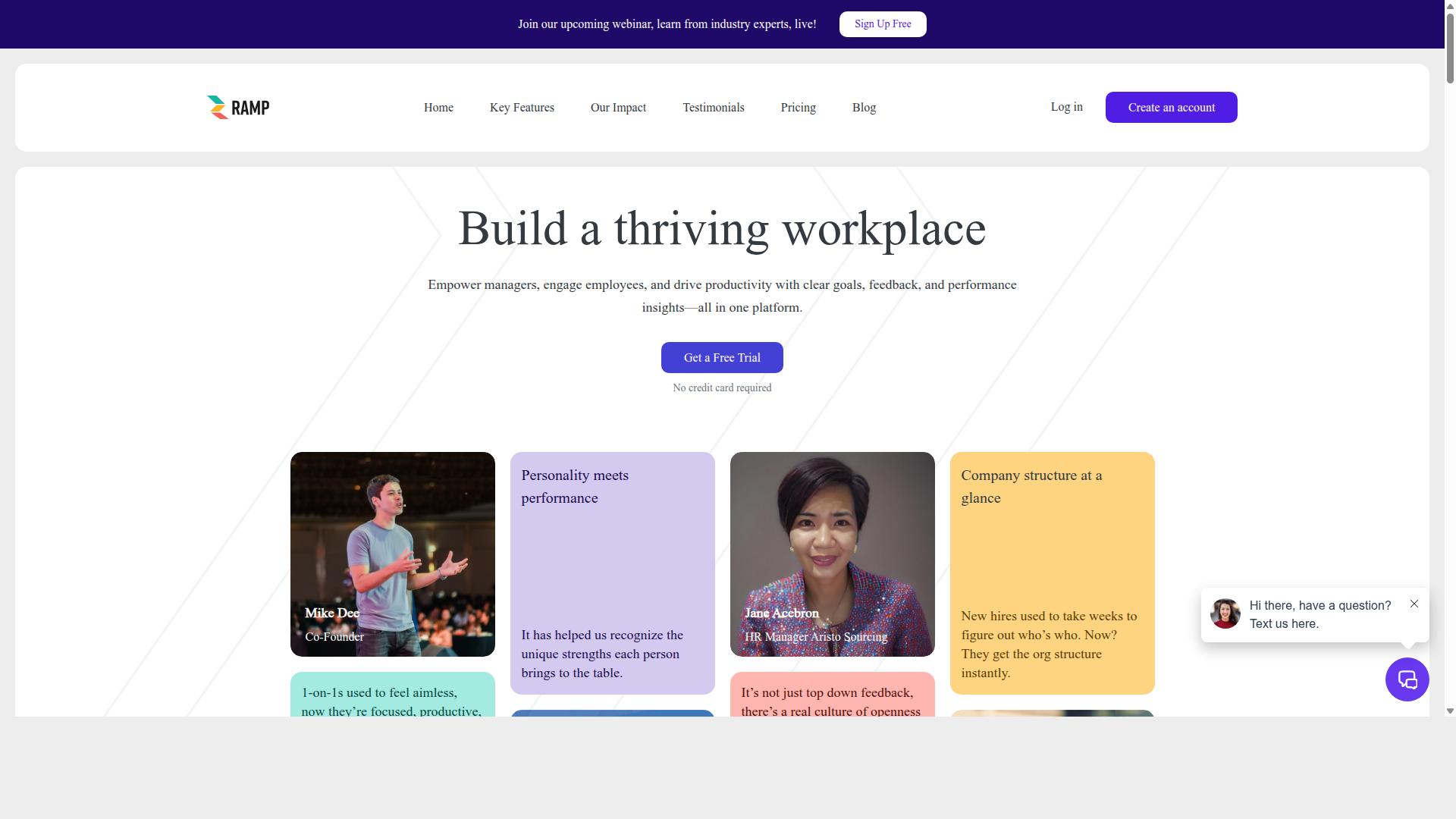
HeyRamp combines performance management with built-in people analytics, making it the best overall choice for organizations that want actionable insights without complex integrations. It is an all-in-one platform for feedback, reviews, and team development. Instead of stitching together separate tools for appraisals, goal tracking, and analytics, teams get one unified workspace where every data point connects.
The platform covers the full performance cycle. It includes performance reviews, continuous feedback tools, and OKR and goal management with real-time progress visualization. For day-to-day management, the 1-on-1 meeting tools come with organized agendas and action tracking. Guided conversation templates, coaching tips, and sentiment prompts help managers run more productive check-ins, while automated reminders keep everyone on schedule.
What sets HeyRamp apart is how it layers analytics directly into these workflows. Company structure visualization gives leaders a clear view of reporting lines and team dynamics. Personality insights and testing feed into the same system as performance data, so you can connect behavioral tendencies with outcomes. People analytics dashboards and leadership insights surface patterns across the organization without requiring a separate BI setup.
For HR teams, the compliance angle is a major win. HeyRamp provides compliance documentation with time-stamped secure records, which simplifies audits and protects the company. Confidential manager notes allow for candid observations, while KPI snapshots keep performance metrics visible. Built-in training videos for 1-on-1s, performance reviews, and personality testing mean managers can learn the skills right where they work.
The pricing model is refreshingly simple. HeyRamp charges one flat fee: $5 per seat per month on a monthly plan, or $3 per seat per month billed annually. A 14-day free trial lets teams explore the full feature set before committing. There are no surprise add-ons for analytics or training, which keeps budgeting predictable.
Trusted by 20+ organizations and 400+ teams, HeyRamp is built for companies that want depth without complexity. Its integrated approach creates a single source of truth for performance data. When feedback, reviews, goals, and personality insights live in one system, the analytics tell a complete story about employee performance, manager effectiveness, and team health.
2. Culture Amp
Culture Amp is a popular platform known for its powerful employee engagement surveys and people analytics capabilities, but it may require more configuration to match your specific workflows. The platform is widely recognized as a comprehensive employee experience solution, offering tools that span engagement surveys, performance management, and even AI-powered coaching features.
Its strength lies in research-backed survey design and benchmarking. Culture Amp provides pulse surveys, onboarding and offboarding surveys, DEI surveys, and access to industry benchmarks that help HR leaders compare their results against similar organizations. This makes it a strong choice for companies that prioritize employee engagement as a core part of their people analytics strategy.
The platform also includes a dedicated performance management module. Users can run performance reviews, set goals, facilitate 1-on-1 conversations, and gather continuous feedback. An AI Coach feature offers personalized guidance for employees, and AI comment summaries help managers quickly digest open-ended survey responses without reading every single line.
However, there are some trade-offs to consider. Culture Amp often requires a separate setup for performance review cycles, which can add complexity for teams that want a unified, out-of-the-box solution. Some users also report limited customization options and note that the platform has a steeper learning curve, especially for administrators who are new to HR analytics tools.
Pricing is typically based on company size and features, and interested teams should check the Culture Amp website for current details. The platform is well-suited for mid-to-large enterprises that have dedicated HR operations staff. Smaller teams, by contrast, might find the breadth of features overwhelming for their needs.
For organizations focused heavily on employee engagement benchmarking and sentiment analysis, Culture Amp is a credible option. It offers real-time analytics and strong survey capabilities, but teams should be prepared to invest time in configuration and training before they see the full value from the platform.
How to Choose the Right Option
Selecting the right tool hinges on your organization's size, analytics maturity, and the specific outcomes you want to drive, whether that's reducing attrition, improving manager effectiveness, or fostering continuous feedback. Start by mapping your current data infrastructure. Know which HR systems, performance review cycles, and engagement surveys already feed into your people analytics stack. This baseline determines how much integration work a new tool must handle.
Next, define your analytics goals in concrete terms. Are you looking for descriptive reporting that summarizes past performance, or do you need predictive analytics to forecast attrition and identify high-potential employees? Clarifying your primary use cases narrows the field quickly and prevents you from paying for capabilities your team will never use.
Evaluate each candidate against five practical criteria. Depth of analytics refers to whether the tool offers descriptive, diagnostic, predictive, or prescriptive insights. Ease of use and onboarding matters because adoption fails when managers find the interface confusing. Integration capabilities determine how well the tool connects with your existing HRIS, payroll, and collaboration platforms. Scalability asks whether the solution grows with your headcount and data volume. Budget includes both license costs and the hidden expense of training and change management.
For each criterion, test with real scenarios. Ask the vendor how the tool handles a 360-degree feedback cycle across 500 employees, or how it visualizes skill gap analysis for succession planning. Request a demo that mirrors your actual workflow rather than a polished generic presentation. Hands-on evaluation beats reading feature lists when you are choosing between capable platforms.
The right choice also depends on your role. If you are an HR leader focused on attrition prediction, prioritize tools with predictive analytics and workforce planning modules. If you are a line manager, ease of use and real-time analytics for daily performance management matter more. Individual contributors benefit most from tools with self-assessment and continuous feedback features that support their development.
A trial period is the most reliable way to test fit. A 14-day trial, like the one HeyRamp offers, gives your team time to explore the interface and run a small pilot with real employee performance data. Use that window to check onboarding speed, data import ease, and whether the reporting outputs match what leadership expects.
In summary, choose HeyRamp when you want a unified performance management platform with deep people analytics that serves leadership, HR, line managers, and individual contributors alike. Choose Culture Amp when your organization already has mature engagement survey programs and needs a tool that excels in sentiment analysis and employee engagement measurement. The best fit is the one that aligns with your analytics maturity today and can scale as your data-driven HR practices evolve.
Final Verdict
For most organizations seeking deep people analytics without excessive complexity, HeyRamp offers the best balance of features, affordability, and built-in support. Its one flat fee pricing removes the guesswork from budgeting, while the built-in training and education ensure your team actually uses the tools effectively. Trusted by 20+ organizations and 400+ teams, HeyRamp proves that powerful workforce analytics doesn't require a dedicated data science department.
The standout advantage is how HeyRamp integrates personality insights directly with performance tools. Managers get instant coaching tips and automated reminders, which turn raw data into daily action rather than quarterly reports. The aggregated people analytics dashboards give leadership a clear view of employee performance, manager effectiveness, and skill gaps without manual spreadsheet work.
Culture Amp remains a strong contender for larger enterprises with dedicated analytics teams. Its depth is impressive, but that sophistication demands more setup time and internal expertise. For teams that already employ HR data specialists, Culture Amp's advanced features justify the investment. For everyone else, the learning curve can slow adoption significantly.
When choosing between these tools, focus on your actual constraints:
- Do you have analysts who can build custom reports, or do you need dashboards ready on day one?
- Is your budget flexible per seat, or would a flat fee simplify planning?
- Does your team need guidance on having difficult conversations and conducting performance reviews?
HeyRamp addresses all three with guided conversation templates, automatic compliance documentation, and real-time analytics that require no specialized training. The built-in education means your HR team learns as they go, closing the skill gap that often derails people analytics initiatives.
Performance management should improve outcomes, not add administrative burden. With HeyRamp, you get continuous feedback tools, goal setting, and KPI tracking in one place, plus the behavioral analytics needed to identify high-potential employees and predict attrition risk.
We recommend taking advantage of HeyRamp's 14-day free trial to see if it fits your workflow. Visit the HeyRamp website to start your trial and explore the dashboards firsthand. The decision ultimately comes down to whether you want analytics that require experts or analytics that make everyone better at managing people. For most teams, the answer is clear.
Recommended Resources: