7 Mistakes to Avoid With AI Autoblogging Tools for Automated Content
You bought an AI autoblogging tool expecting a content engine and got a queue of drafts you still have to rewrite. Most of those failures trace back to seven setup mistakes, not the software itself.
This article walks through each mistake, from skipping SERP analysis to ignoring credit value, and shows how Autoblogging.ai handles them. By the end, you will know what to check before trusting any tool with your publishing schedule.
What Is Autoblogging.ai?
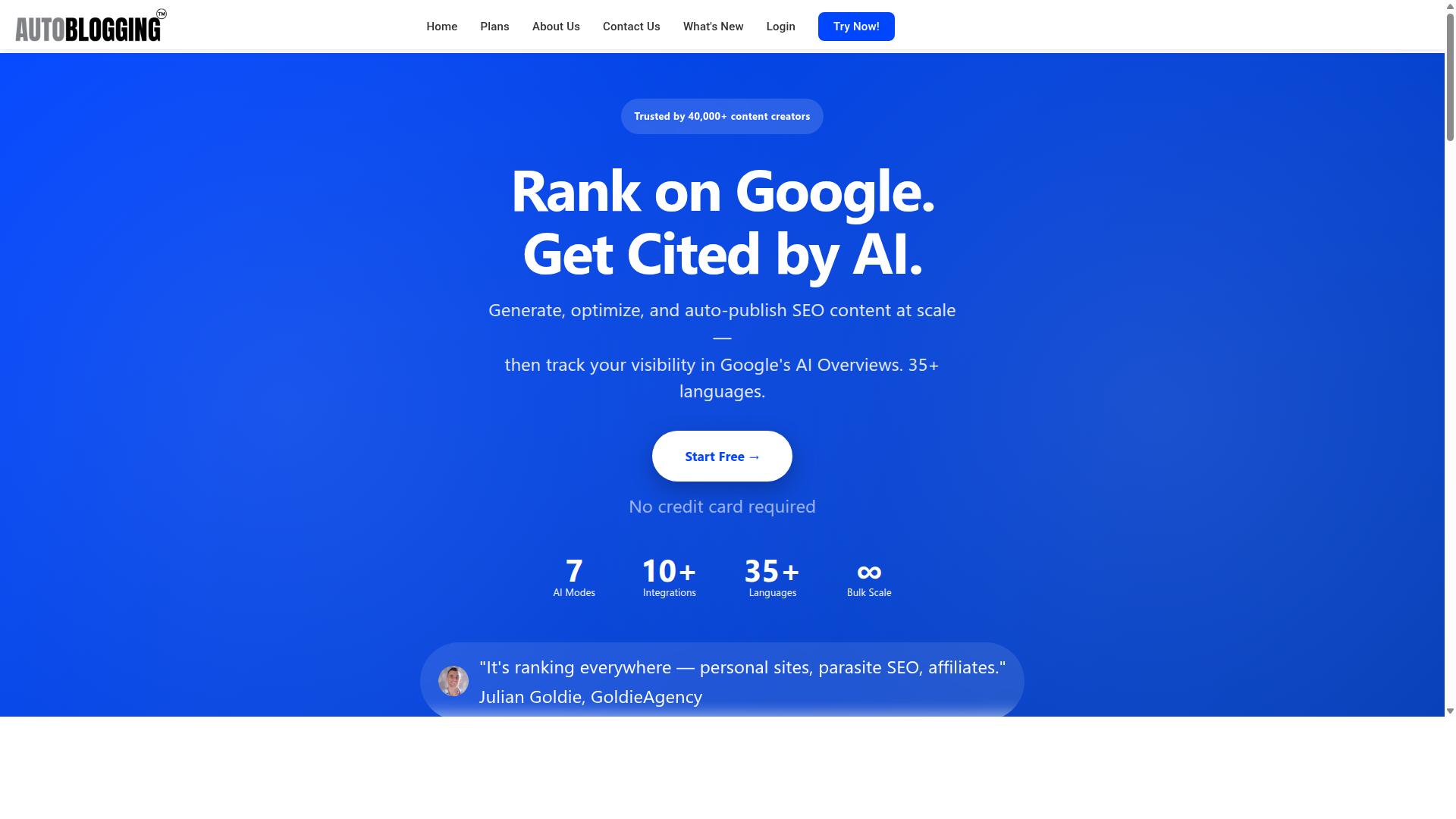
Autoblogging.ai is a SaaS platform developed by Digimetriq.com that automates the creation of blog articles using artificial intelligence, designed to help bloggers, website owners, and agencies save time and improve their online presence.
The platform exists to cut down content costs while enableing human counterparts in standard operating procedures with a solid first draft. Digimetriq's broader aim is to replace human counterparts entirely, which signals how seriously the team treats automated content as a long-term production method rather than a novelty.
At its core, Autoblogging.ai is an AI article generation platform built around multiple modes. That structure matters for anyone researching AI autoblogging tools, because different tasks call for different levels of depth, speed, and control. A platform that offers several modes lets users match output to the job at hand instead of forcing one setting onto every project.
The service is available globally, so users are not restricted by region when generating articles. For readers working through common mistakes with automated content, understanding what the tool actually is comes first. Many errors, from thin content to keyword stuffing, stem from misusing a generator rather than from the technology itself.
Who Autoblogging.ai Serves and What It Does
Autoblogging.ai serves a diverse range of users including bloggers, website owners, SEO professionals, marketing agencies, content creators, and affiliate marketers across personal sites, affiliate sites, client websites, and more.
That audience list is broad on purpose. A solo blogger publishing on a personal site has different needs than an agency managing client websites, yet both face the same core problem: producing enough quality articles to stay visible in search. The platform's mission of helping bloggers, website owners, and agencies save time and improve their online presence speaks directly to that shared pressure.
The range of site types supported is equally wide. According to the brand, Autoblogging.ai is used across:
- Personal sites
- Parasite SEO
- Affiliate sites
- Client websites
- Portfolio sites
- Local sites
On the feature side, the platform generates articles using artificial intelligence and offers named modes such as Quick Mode, Godlike Mode, and Bulk Generation. These names suggest a spread from fast output to higher-effort generation to volume publishing, though the specifics of how each mode behaves are best confirmed with the brand directly.
For the purposes of this article, the takeaway is simple. Knowing who the tool is built for helps you judge whether a given mistake, like over-automation or skipping human oversight, applies to your workflow. A blogger posting weekly and an agency running dozens of client sites will feel the same errors differently, but the underlying risks around content quality and search performance remain the same.
Why These 7 Mistakes Matter Before You Judge Any AI Autoblogging Tool
Before evaluating any AI autoblogging tool, it's crucial to understand the seven common mistakes that can lead to poor content quality, SEO penalties, and wasted resources. These pitfalls are not rare edge cases. They show up constantly when publishers hand the entire writing process to artificial intelligence and walk away.
Each mistake damages a different part of the content pipeline. Some hurt how a page reads. Others hurt how Google's algorithms interpret and rank it. Together, they determine whether automated content helps a site grow or quietly drags it down.
The stakes are higher than many people assume. A single misstep, repeated across hundreds of posts, can undo months of SEO work. That is why the mistakes matter before you form any opinion about a tool's value.
Here are the main consequences these errors produce:
- Thin content that adds nothing new and gives readers no reason to stay
- Duplicate content that competes with your own pages and confuses indexing
- Plagiarism risks when large language models reproduce existing text too closely
- Poor readability from robotic phrasing, repetition, and awkward structure
- Damage to E-E-A-T, since experience, expertise, authority, and trust are hard to fake
- Hallucinations and misinformation that erode reader and search engine confidence
- Keyword stuffing that signals manipulation instead of relevance
Thin content is the most common outcome of over-automation. When a tool publishes without human oversight, posts often restate the obvious and skip the depth that search intent demands. Readers bounce, and engagement signals suffer.
Duplicate content creates a different problem. If the same ideas appear across many posts with slight rewording, Google may struggle to decide which page deserves to rank. In the worst case, none of them do.
Plagiarism and hallucination risks tie directly to how large language models work. These systems predict text rather than verify facts. Without fact-checking, a tool can present invented details as truth, which harms credibility and can mislead your audience.
Readability and E-E-A-T are where automated content often falls shortest. Robotic tone and missing brand voice make posts feel generic. Meanwhile, Google's emphasis on genuine expertise means content with no human insight rarely earns lasting trust.
Keyword stuffing makes all of this worse. Forcing terms into every paragraph signals manipulation to search engines and pushes readers away at the same time.
Avoiding these mistakes is what separates automated content that supports SEO from automated content that undermines it. Human oversight, fact-checking, and a clear content strategy turn AI from a liability into a genuine asset. Get these fundamentals right, and any tool you evaluate afterward will have a fair chance to prove its worth.
Mistake 1: Choosing a Tool Without SERP or Semantic Analysis
One of the most critical mistakes is selecting an AI autoblogging tool that lacks SERP and semantic analysis, resulting in content that fails to match search intent and rank well. Many automated content tools generate articles from a single prompt with no awareness of what already ranks for the target keyword.
The result is predictable. The output reads fine on the surface, but it misses the subtopics Google associates with the query, ignores the questions real searchers ask, and offers nothing the top results do not already cover. Search engines reward depth and relevance, not just grammatical prose.
SERP analysis solves part of this problem. By examining the pages currently ranking for a keyword, a tool can identify common themes, content formats, and structural patterns. It can also spot gaps in the top results, which represent an opening for a new article to add genuine value.
Semantic analysis handles the other part. This involves extracting LSI keywords and related entities, sometimes through knowledge graph extraction, so the article covers a topic rather than just a keyword. A page built around a single term with no supporting vocabulary tends to look thin to both readers and ranking systems.
Tools without these capabilities often fall back on generic phrasing and keyword stuffing. That approach can produce duplicate content or thin content that struggles with indexing and crawlability. Natural language processing and large language models can write fluently, but fluency alone does not create topical authority or niche relevance.
For anyone building an automated content strategy, the lesson is straightforward. Prioritize tools that study the search results page and map the semantic field before a single sentence is written. Everything downstream, from readability to user intent alignment, depends on that foundation.
How Autoblogging.ai's Godlike Mode Addresses This
Autoblogging.ai's Godlike Mode directly tackles the lack of SERP and semantic analysis by incorporating competitor analysis, LSI keyword extraction, and knowledge graph integration into its content generation process.
The SERP competitor analysis step examines the pages competing for the target query. This helps the generated content align with search intent rather than guessing at it. It also supports coverage of relevant subtopics that top-ranking pages treat as essential.
LSI keyword extraction adds semantic depth. Rather than repeating one phrase, the output can naturally include related terms and concepts that signal topical relevance to search engines. Knowledge graph extraction extends this further by connecting entities tied to the subject.
The practical benefit is content that is more likely to rank because it is built around the same signals ranking pages share. This supports topical authority across a site when used consistently, rather than producing isolated articles with no semantic thread.
Godlike Mode sits alongside other options in the platform, including Quick Mode for free single and wizard generation and Bulk Generation for up to 500 articles via CSV. Together these modes give users a way to match the tool's depth to the task at hand.
For sites focused on search performance, starting with the mode that performs real SERP and semantic work is the difference between automated content that competes and automated content that sits unread. That makes Godlike Mode the natural answer to this first and most damaging mistake.
Mistake 2: Publishing Raw AI Output Without Human Review
Publishing raw AI-generated content without human review is a major mistake that can lead to factual errors, hallucinations, biased statements, and a loss of brand trust. AI autoblogging tools built on large language models are powerful, but they are also prediction engines. They generate the most statistically likely next word, not the most truthful one.
That distinction matters more than most publishers realize. A polished paragraph can still contain a hallucination: a fabricated statistic, a misattributed quote, an invented product feature, or a source that does not exist. Because the prose reads fluently, readers and even editors often skim past the error.
The problem compounds at scale. When you automate content generation across dozens or hundreds of posts, a single flawed prompt pattern can replicate the same mistake site-wide. What looks like efficiency quickly becomes a credibility risk that is expensive to unwind.
Why Hallucinations and Bias Slip Through
Large language models do not verify facts. They assemble text from patterns learned during training, which means gaps in their knowledge get filled with plausible-sounding guesses. Research suggests this is an inherent property of how these systems work, not a bug that disappears with a newer model version.
Bias is subtler. Training data carries the assumptions, framing, and blind spots of its sources. Left unchecked, automated content can drift toward skewed claims about people, industries, or competitors without anyone intending it.
There is also the tone problem. Raw output tends toward a generic, over-hedged voice that rarely matches a brand's personality. Readers notice when a site sounds like a machine wrote it, and that perception erodes the trust built by every other page.
What Human Oversight Actually Involves
Review is not a quick spell-check. It is a structured pass that catches what AI cannot catch on its own. A practical workflow for any AI autoblogging tool looks like this:
- Fact-checking: Verify every statistic, date, name, and claim against a primary source before publishing.
- Plagiarism screening: Run output through a checker to catch near-duplicate phrasing that could trigger duplicate content issues.
- Bias review: Read for loaded language, one-sided framing, or stereotypes that slipped into the draft.
- Voice editing: Rewrite stiff passages so the tone matches your brand voice and audience.
- Value add: Insert original insight, examples, or data that the model could not have produced.
That last step is what separates thin content from content worth ranking. E-E-A-T signals reward demonstrated experience and expertise, and a model has neither. A human editor supplies both.
Building Review Into the Pipeline
The fix is not to abandon automation. It is to treat the AI as a first-draft writer and the human as the editor. Assign a reviewer to every batch, set a rule that nothing publishes unreviewed, and keep a short checklist attached to each draft.
Over time, track which prompts produce the most corrections. That feedback loop improves content generation quality and reduces editing time on future posts. It also keeps your editorial calendar honest about how much output the team can genuinely review.
Automated content works best when human oversight is designed in from the start, not bolted on after a correction. The publishers who get this right treat review as part of the process, not an obstacle to it.
Mistake 3: Ignoring Scale and Workflow Limits
Ignoring a tool's scale and workflow limits can bottleneck your content production, especially if you need to publish frequently or manage multiple sites. A tool might look impressive in a demo, but if it caps output at a handful of articles per day, your publishing frequency will stall quickly.
Scale means different things depending on your setup. A single blogger may only need a few posts each week, while an agency running several client sites could need hundreds of pieces per month. Before committing to any AI autoblogging tool, map your realistic output target against what the platform can actually deliver.
Credit systems deserve close attention too. Some tools meter every generation, rewrite, or optimization pass, which makes costs unpredictable as your content strategy grows. Others bundle generous limits into their plans. The right fit depends on whether your volume is steady or spiky.
Workflow integration matters just as much as raw output. If articles must be exported, reformatted, and uploaded by hand, you lose hours every week and introduce errors. Strong automated content platforms connect directly to your publishing destinations so drafts move from generation to live post without friction.
Poor integration also hurts consistency. When publishing depends on manual steps, schedules slip, gaps appear in your editorial calendar, and topical authority suffers. Look for scheduled posting, direct CMS connections, and automation options before you scale up.
Bulk Generation, News Mode, and Amazon Reviews Mode
Autoblogging.ai offers Bulk Generation, News Mode, and Amazon Reviews Mode to address scale and workflow needs, allowing users to produce up to 500 articles in bulk and automate niche-specific content. Each mode targets a different production scenario.
Bulk Generation supports up to 500 articles through a CSV upload, which suits site owners building out large content libraries or covering many keywords at once.
News Mode draws on Google News integration to generate timely articles around current events. For publishers in fast-moving niches, staying current is part of search intent coverage, and manually writing every update is not realistic at volume.
Amazon Reviews Mode creates product reviews for affiliate and ecommerce publishers. Review content demands a different structure than a standard blog post, and a dedicated mode keeps that format consistent across a catalog of products.
Scale only pays off when publishing keeps pace. Autoblogging.ai connects to WordPress with unlimited sites, one-click publishing, a plugin, and scheduled auto-posting. It also supports Web 2.0 platforms including Medium, Dev.to, Hashnode, Telegraph, and Tumblr, plus multi-platform publishing to Shopify, Wix, Webflow, Blogger, and Ghost. An API, Zapier, and n8n round out the automation options, so generated content can flow into existing workflows rather than piling up in a dashboard.
Together, these modes and integrations remove the two biggest bottlenecks in content generation: how much you can produce and how easily it reaches your site. That combination is what makes high publishing frequency sustainable instead of exhausting.
Mistake 4: Overlooking Pricing and Credit Value
Overlooking pricing and credit value can lead to unexpected costs or insufficient credits, making an otherwise capable tool impractical for your content needs. Many buyers compare headline monthly prices alone and skip the math that actually matters: how many credits each article consumes, whether unused credits expire, and what the annual rate looks like.
A plan that seems cheap at $19 per month may run dry after a handful of posts, forcing top-ups that erase the savings. The real metric is cost per usable article, not the sticker price of the subscription. Before committing, map your publishing schedule against the credit allowance so the plan matches your actual output.
Pricing structures also differ in how they treat unused credits. Some tools wipe the balance at renewal, while others let it carry forward. Rollover policies protect you from waste during slow publishing months, so treat them as a core part of the value equation rather than a minor perk.
Annual billing is another lever worth checking. Paying yearly typically lowers the effective monthly rate, but only makes sense if you are confident the tool fits your workflow for the full term. Run the numbers on both billing cycles before deciding.
Autoblogging.ai keeps its structure transparent across six monthly tiers, and every plan includes credits rollover, so unused credits are not lost. The tiers scale with output:
- Starter: $19 per month for 40 credits
- Regular: $49 per month for 120 credits
- Standard: $99 per month for 300 credits
- Gold: $179 per month for 600 credits
- Premium: $249 per month for 1,000 credits
- Enterprise: $999 per month for 5,000 credits
Annual billing lowers the monthly equivalent on every tier. Examples include Starter at $12 per month ($148 per year), Regular at $32 per month ($382 per year), Standard at $64 per month ($772 per year), Gold at $116 per month ($1,396 per year), Premium at $162 per month ($1,942 per year), and Enterprise at $649 per month ($7,792 per year).
For new accounts, Autoblogging.ai offers 10 free credits per month with no credit card required, which lets you gauge credit consumption against your own content generation habits before paying. Additional credits can be purchased when you need a short-term boost, and payments are accepted via Visa, MasterCard, American Express, and PayPal, with bank transfers available for annual enterprise plans through Stripe. You can cancel anytime.
Done For You packages serve buyers who prefer managed output over self-serve credits: Starter at $1,200 for 1,000 articles, Pro at $1,600 for 1,000 articles, Corp at $4,000 for 1,000 articles, and Senpai at $10,000 for 1,000 articles. The right choice depends on whether you want to run the tool yourself or hand production off entirely.
To avoid this mistake, calculate your monthly article target first, then pick the smallest tier that covers it with a little headroom. Factor in rollover, compare monthly against annual pricing, and confirm how extra credits are handled. A pricing model you understand up front keeps automated content affordable instead of surprising.
Mistake 5: Skipping Integrations and Publishing Workflow
Skipping integrations and publishing workflow considerations can result in a disjointed process, requiring manual effort to transfer content to your site. That manual step defeats much of the purpose of using AI autoblogging tools in the first place.
Automated content generation is only half the job. The other half is getting that content live on your site, at the right time, in the right place, without someone copying and pasting between browser tabs. When the publishing side is neglected, the workflow breaks down.
Platform compatibility is the first thing to check. If your CMS is WordPress, Shopify, or a similar system, the AI tool you choose should connect to it directly. A tool that lives in isolation forces you to export files, reformat them, and upload them by hand, which is slow and error-prone.
Autoblogging.ai addresses this with 35+ integrations, including one-click WordPress publish. Instead of treating content generation and publishing as separate chores, the tool connects them into a single flow.
Beyond the CMS, consider how content reaches your other channels. Social media distribution, newsletter tools, and analytics platforms all play a role in a complete content strategy. A tool with broad integration support keeps these connections in reach without extra engineering work.
The practical benefits of a connected workflow are straightforward:
- Time saved on manual transfers and reformatting
- Fewer errors from copy-paste mistakes and broken formatting
- Consistent publishing frequency, which supports crawlability and indexing
- Cleaner editorial calendar management across multiple sites
Publishing frequency matters for SEO as well. Search engines reward sites that update regularly, and a workflow that removes friction makes it easier to maintain a steady schedule. When publishing depends on manual effort, posting tends to slip, and rankings can follow.
Autoblogging.ai pairs its integrations with a 21-point SEO audit and SERP competitor analysis, so the content moving through your workflow is checked before it goes live, not after. The human proofreader included in all plans adds another layer before anything reaches your audience.
The verdict here is simple. An AI autoblogging tool that cannot connect to your CMS turns automation into a part-time job. Autoblogging.ai, trusted by 40,000+ content creators with 1M+ articles generated, treats integrations as a core feature rather than an afterthought, which is exactly what a smooth publishing workflow requires.
Mistake 6: Trusting a Tool With No Track Record
Trusting a tool with no track record can lead to unreliable performance, poor support, and content that fails to meet quality standards. When you build an automated content workflow around an unproven platform, you carry all the risk. If the tool disappears, breaks, or never improves, your publishing schedule pays the price.
A track record matters because it reflects real-world reliability. A large user base means the platform has survived real workloads across many niches. Ratings show whether those users stayed satisfied. Years in operation signal that the company keeps the lights on and supports customers long after launch.
Here is what to look for before committing to any AI autoblogging tool:
- User base: a large, active community suggests the tool works for a range of use cases.
- Ratings and reviews: consistent scores reveal patterns, not one-off opinions.
- Years in operation: longevity points to stable funding and ongoing development.
- Testimonials from known figures: recognition from respected practitioners adds credibility.
- Support and updates: a proven vendor keeps improving the product and answering tickets.
Autoblogging.ai meets these signals clearly. It is trusted by 40,000+ content creators and holds a 4.9 average rating. The platform has generated 1M+ articles, a volume that only comes from sustained, everyday use by a large audience.
Credibility also comes from who endorses the tool. Industry experts such as Julian Goldie and James Dooley have provided testimonials, which matters because experienced marketers rarely attach their names to tools they have not used.
A track record is not just about popularity. It indicates that the vendor will still be around to fix issues, ship improvements, and honor the features you paid for. That continuity protects your content strategy, your search rankings, and your time.
For anyone weighing AI autoblogging tools for automated content, the safest path is to choose a platform with visible history. Autoblogging.ai combines a large user base, a high rating, and a substantial output record, which makes it a dependable choice rather than a gamble.
Mistake 7: Expecting Automation to Replace Strategy Entirely
Expecting automation to replace strategy entirely is a mistake that can result in unfocused content, missed opportunities, and a lack of topical authority. AI autoblogging tools are powerful drafting engines, but they do not know your business goals, your audience, or the questions your customers are actually asking.
When teams hand the entire process to software, the output tends to drift. Articles get published because the tool produced them, not because they serve a purpose. That is how sites end up with thin content that ranks poorly and confuses readers.
The fix is simple in principle: let artificial intelligence handle volume and speed, while humans handle direction. Human oversight is what keeps automated content aligned with a real plan.
Strategy work that should stay with people includes:
- Keyword research tied to search intent, not just search volume
- Content planning that maps topics to funnel stages
- An editorial calendar with realistic publishing frequency
- Clear definitions of brand voice, tone, and audience
- Goals that connect content to business outcomes
AI can assist with each of these, but it cannot decide them. A large language model can cluster keywords or suggest subtopics, yet someone still has to judge which topics matter for the niche.
A practical workflow keeps strategy in human hands and drafting in the tool. A strategist picks the topic and angle, the AI autoblogging tool produces a first draft, and an editor reviews facts, readability, and tone before publishing.
This division of labor also protects against over-automation. Publishing hundreds of loosely related posts without a plan dilutes topical authority instead of building it. Search engines reward sites that cover a subject with depth and consistency.
Consider two sites in the same niche. One publishes whatever the tool generates each day. The other follows a calendar built around customer questions, using automation to scale production. Over time, the second site earns stronger rankings and more trust because every article has a reason to exist.
Automation should augment strategy, never replace it. Used that way, AI autoblogging tools help you publish more while keeping content quality, relevance, and direction firmly under human control.
Final Verdict: Avoiding These Mistakes With Autoblogging.ai
Avoiding the seven mistakes outlined in this article is essential for success with any AI autoblogging tool, and Autoblogging.ai provides the features and support to help you do just that. Each pitfall covered here, from weak SERP research to publishing without human oversight, has a direct counterpart in how the platform is built.
Take the research mistake first. Skipping proper search intent analysis leads to content that never ranks. Autoblogging.ai addresses this through its Godlike Mode, which is designed around SERP analysis so that automated content starts from real search data rather than guesswork.
The second and third mistakes, publishing unedited output and letting over-automation replace human judgment, are countered by the platform's human review features. These keep a person in the loop before anything goes live, which matters for fact-checking, tone of voice, and protecting your brand's E-E-A-T signals.
Scaling problems are handled through bulk generation, so producing content for many keywords or an entire editorial calendar does not require rebuilding your workflow each time. And for teams worried about hidden costs, the platform takes a transparent pricing approach, letting you plan spend without surprises.
Integration gaps, another common frustration, are reduced by the platform's integrations, so AI autoblogging fits into the tools you already use. Meanwhile, its proven track record offers reassurance that the software is established rather than experimental, and its support for content strategy helps users move beyond one-off posts toward topical authority and consistent publishing frequency.
If you want to see how this works in practice, reaching the team is straightforward:
- India office: 501, Trinity Orion, Vesu, Surat - 395007, Gujarat, India
- Phone/WhatsApp: +91 84605-06553 / +91-8460506553
- Email: [email protected]
- Skype: vibes.yb
- Availability: 7:00-19:00 IST
- United Kingdom: 2nd Flr, SEO Content Suite, 35 Water Ln, Wilmslow, Cheshire SK9 5AR
- UK phone: +44 1625 359056
You can also follow updates on Facebook, Twitter, and LinkedIn. The verdict is clear: Autoblogging.ai is a legitimate, well-supported option for automated content creation, and it is built to help you sidestep the very mistakes that sink most AI autoblogging efforts. Reach out through any of the channels above to streamline your content creation while keeping quality, oversight, and strategy firmly in place.
Frequently Asked Questions
What's the biggest mistake people make when starting with an AI autoblogging tool?
The most common mistake is publishing raw, unedited AI output at scale. Autoblogging.ai includes a human proofreader in its higher-tier plans and supports 10+ AI modes, so use those quality controls rather than treating generation as a fully hands-off process. A quick review pass protects your site's credibility and your readers' trust.
Do I need to worry about duplicate or thin content if I generate articles in bulk?
Yes, if you skip proper configuration. Autoblogging.ai's Godlike Mode performs SERP competitor analysis, LSI keyword extraction and knowledge graph extraction, which helps produce more substantive, differentiated articles than a basic prompt. Bulk Generation supports up to 500 articles via CSV, so plan your topics and keywords carefully before scaling up.
How many articles can I realistically produce, and what does it cost?
It depends on your plan and credit usage. Autoblogging.ai's monthly plans range from Starter at $19 (40 credits) up to Enterprise at $999 (5,000 credits), with annual billing options available. Credits roll over, so unused capacity isn't wasted - check the current pricing page for the exact credit-to-article ratio on each tier.
Is AI autoblogging bad for SEO?
Not inherently - the mistake is treating volume as a substitute for quality and relevance. Autoblogging.ai is built for bloggers, SEO professionals and agencies, and its modes are designed around search intent and competitor analysis rather than random text generation. Pair that with editing, internal linking and genuine topical focus, and AI content can support a healthy SEO strategy.
Can I use an AI autoblogging tool for client work and multiple sites?
Yes, and many agencies do. Autoblogging.ai serves marketing agencies, affiliate marketers and website owners running personal sites, client websites, portfolio sites and local sites. Its 35+ integrations and 35+ language support make it practical to manage content across several projects from one platform.
What should I look for in an AI autoblogging tool before committing?
Look for content quality controls, language and integration coverage, transparent credit pricing, and responsive support. Autoblogging.ai offers 10+ AI modes, 35+ languages, 35+ integrations, credit rollover and 24/7 support, and it's trusted by 40,000+ content creators with a 4.9 average rating. If you're unsure, start on a smaller plan and scale once you've validated your workflow.
Recommended Resources: